
Spotted Lanternfly Damage: How to Protect Your Garden

Quick Answer: Spotted lanternflies damage plants by feeding on sap and excreting a sticky substance called honeydew, which promotes black sooty mold and weakens or kills plants over time. You can protect your garden by removing egg masses, using targeted insecticides or neem oil, setting traps, and reporting infestations to your state agriculture department. Acting early in the season gives you the best chance of limiting damage.
Key Takeaways
- Spotted lanternflies (Lycorma delicatula) feed on over 70 plant species, but grape vines, hops, apples, and Tree of Heaven are among the most vulnerable.
- The insects excrete honeydew, which coats plants and leads to black sooty mold, blocking sunlight and further stressing the plant.
- Scraping and destroying egg masses in fall and winter is one of the most effective ways to reduce next season’s population.
- Sticky band traps can help monitor populations but require wildlife guards to avoid trapping birds and small animals.
- Neem oil and insecticidal soaps are lower-impact options; systemic insecticides containing dinotefuran or imidacloprid are more effective for heavy infestations.
- Professional treatment typically costs between $150 and $400 per visit, depending on property size and infestation severity (cost estimates based on 2025 industry averages).
- No plant is fully “lanternfly-proof,” but certain aromatic herbs may deter feeding to a limited degree.
- If you spot a large infestation, report it to your state’s department of agriculture immediately.
- Common mistakes include using sticky bands without guards, ignoring egg masses, and applying broad-spectrum pesticides that kill beneficial insects.
What Does Spotted Lanternfly Damage Look Like on Plants?
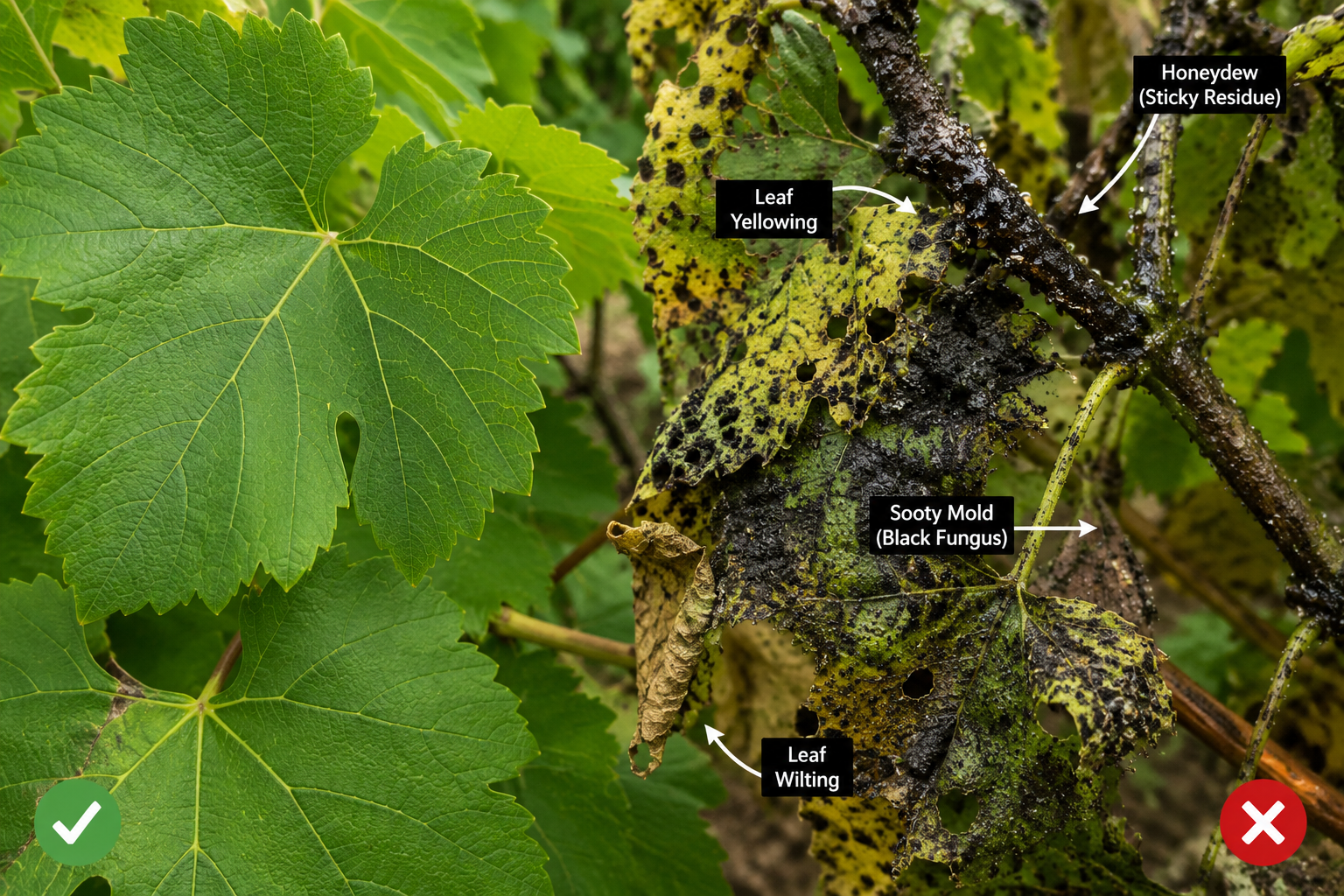
Spotted lanternfly damage shows up as wilting, oozing sap, yellowing leaves, and a thick, shiny coating of sticky honeydew on stems and surrounding surfaces. As the season progresses, black sooty mold grows on that honeydew, leaving plants looking scorched or coated in soot.
Here is what to look for at each stage:
- Early feeding signs: Weeping or oozing wounds on bark, small sap trails running down stems.
- Mid-season: Yellowing or curling leaves, reduced fruit production, sticky residue on the ground beneath the plant.
- Late-season: Black sooty mold on leaves and branches, fermented smell from honeydew, visible swarms of nymphs or adults on stems.
Common mistake: Many gardeners confuse sooty mold with fungal disease or aphid damage. The key difference is the sheer volume of sticky residue and the presence of the insects themselves, often clustered in large groups on the lower trunk.
What Plants Are Most at Risk from Spotted Lanternflies?
Spotted lanternflies have been documented feeding on more than 70 plant species, but they show a strong preference for a handful of hosts. According to the USDA Animal and Plant Health Inspection Service (APHIS), the highest-risk plants include:
| Plant Type | Risk Level | Notes |
|---|---|---|
| Grape vines | Very High | Can cause near-total crop loss |
| Hops | Very High | Major commercial concern |
| Apple and stone fruits | High | Weakens trees, reduces yield |
| Tree of Heaven (Ailanthus) | Very High | Primary host; removing it helps |
| Maple, walnut, birch | Moderate | Less lethal but still stressed |
| Roses, ornamental trees | Moderate | Cosmetic and structural damage |
If you grow grapes or fruit trees, understanding spotted lanternfly damage and how to protect your garden is especially urgent.
How Do Spotted Lanternflies Actually Kill Plants?
Spotted lanternflies kill plants by piercing the phloem (the plant’s nutrient highway) with needle-like mouthparts and extracting large amounts of sap. This constant drain weakens the plant’s ability to photosynthesize and store energy for winter.
The process works in three damaging steps:
- Sap removal: The insect drains carbohydrates the plant needs for growth and cold hardiness.
- Honeydew buildup: Excess sugar is excreted as honeydew, which coats leaves and blocks sunlight.
- Sooty mold colonization: Mold fungi colonize the honeydew, further reducing photosynthesis and inviting secondary infections.
Young plants and vines under three years old are at the greatest risk of dying outright. Mature trees often survive but show reduced vigor, lower fruit yield, and increased vulnerability to other stressors like drought or disease.
Is It Too Late to Protect My Garden Once You See Lanternflies?
No, it is not too late once you see them, but the window for the most effective action narrows quickly. Early-season nymphs (April through June in most infested states) are easier to kill than late-season adults, and intervening before egg-laying in September and October prevents next year’s population from exploding.
Choose your timing based on what you see:
- Egg masses only (fall/winter): Scrape and destroy them now. This is your highest-leverage action.
- Small black nymphs (spring): Neem oil, insecticidal soap, or circle traps work well at this stage.
- Large red nymphs or adults (summer/fall): Systemic insecticides are more effective; contact sprays require repeated applications.
Even if you see a full swarm, treatment can still reduce damage significantly and protect plants through the rest of the season.
What Are Some Natural Ways to Get Rid of Spotted Lanternflies?
Several lower-impact methods can reduce spotted lanternfly populations without broad pesticide use. None of them eliminate an infestation entirely, but they are useful as part of a layered approach.
- Neem oil: Disrupts feeding and development in nymphs. Apply every 7 to 14 days during active feeding season.
- Insecticidal soap: Kills on contact; effective on nymphs, less so on adults.
- Diatomaceous earth: Apply around the base of plants to deter crawling nymphs.
- Hand-removal and squishing: Labor-intensive but effective for small gardens.
- Circle traps: Funnel insects into a collection bag as they climb trees; no chemicals needed.
- Removing Tree of Heaven: Eliminating this preferred host from your property reduces local populations over time.
Edge case: Natural predators like spiders, praying mantises, and some birds do eat spotted lanternflies, but not in numbers large enough to control an infestation on their own.
Do Sticky Bands Really Work for Lanternflies, or Are They Overrated?
Sticky bands do capture spotted lanternflies, but they have real limitations and safety risks that make them a monitoring tool rather than a primary control method. Without wildlife guards (wire mesh cages around the band), they trap birds, small mammals, and beneficial insects.
When sticky bands make sense:
- You want to monitor population levels on a specific tree.
- You are using them alongside other control methods.
- You have installed proper wildlife guards as recommended by Penn State Extension.
When to skip them: If you have pets, children, or significant wildlife activity in your yard, the risk of unintended harm outweighs the benefit for population control.
What Is the Best Insecticide for Spotted Lanternflies Without Harming Other Bugs?
For targeted control with lower impact on pollinators, systemic insecticides applied as soil drenches (rather than sprays) are the best balance. Products containing dinotefuran or imidacloprid are absorbed by the plant and kill insects that feed on it, reducing exposure to bees and other non-feeding visitors.
- Dinotefuran (e.g., Safari 20SG): Faster uptake, effective within days; approved for residential use in many states.
- Imidacloprid (e.g., Bayer Tree and Shrub): Slower uptake but longer residual; avoid on flowering plants to protect pollinators.
- Pyrethrin sprays: Fast-acting contact killers but broad-spectrum; use only in the evening when bees are inactive.
Do not apply systemic insecticides to plants in bloom. Residues in pollen and nectar can harm bees even when the spray itself is targeted.
How Much Does It Cost to Have a Professional Treat Spotted Lanternflies?
Professional spotted lanternfly treatment typically runs between $150 and $400 per visit for a residential property, based on 2025 industry pricing reported by pest control services in the mid-Atlantic region. Larger properties or severe infestations can push costs higher.
What affects the price:
- Property size and number of trees treated
- Treatment method (soil drench vs. trunk injection vs. foliar spray)
- Number of follow-up visits needed (most programs require 2 to 3 per season)
- Geographic location and local market rates
Some state agriculture departments offer free resources, identification help, and occasionally subsidized treatment programs. Check your state’s department of agriculture website for current assistance options.
Are There Any Plants That Repel Spotted Lanternflies?
No plant has been scientifically proven to repel spotted lanternflies reliably. However, some gardeners and researchers have noted that the insects show less interest in strongly aromatic herbs like lavender, mint, and rosemary, possibly because the scent masks host plant cues.
Practical approach: Plant aromatic herbs as companion plants near high-risk crops, but treat them as a supplemental deterrent, not a solution. Removing Tree of Heaven from your property remains the single most impactful habitat modification you can make.
What Should I Do If I Find Spotted Lanternfly Eggs in My Garden?
Finding egg masses is actually good news: you can eliminate next year’s population before it hatches. Egg masses look like smears of dried mud or putty, roughly one inch long, often found on tree bark, stone walls, outdoor furniture, and vehicles.
Step-by-step removal:
- Scrape the mass into a zip-lock bag using a credit card or putty knife.
- Add hand sanitizer or rubbing alcohol to the bag to kill the eggs.
- Seal the bag and dispose of it in the trash (not compost).
- Report the find to your state agriculture department, especially if you are in a newly infested county.
Do this between October and May, before eggs hatch in late April or early May.

Can Spotted Lanternflies Harm My Fruit Trees, and How Is Their Damage Different from Other Pests?
Yes, spotted lanternflies can seriously harm fruit trees including apple, peach, cherry, and plum. Heavy feeding reduces fruit size, sugar content, and overall yield, and repeated infestations over multiple seasons can kill younger trees.
How to tell spotted lanternfly damage apart from other pests:
| Damage Type | Spotted Lanternfly | Aphids | Scale Insects |
|---|---|---|---|
| Honeydew/sooty mold | Yes, heavy | Yes, lighter | Yes, moderate |
| Visible insects | Large, colorful adults | Tiny, clustered | Flat, shell-like |
| Bark oozing | Yes | Rare | Rare |
| Group behavior | Large swarms | Colonies | Stationary colonies |
| Season | Spring through fall | Spring primarily | Year-round |
If you see large, colorful insects (gray wings with black spots, red underwings) clustered on your tree trunk in groups of dozens or hundreds, it is almost certainly spotted lanternflies.
Who Should I Call If I See a Large Spotted Lanternfly Infestation?
Report a large infestation to your state’s department of agriculture. In the U.S., you can also report sightings to the USDA APHIS online reporting portal. Most infested states (Pennsylvania, New Jersey, New York, Virginia, and others) have dedicated spotted lanternfly hotlines and online forms.
Who to contact:
- State department of agriculture: First point of contact for identification and reporting.
- Penn State Extension or your state land-grant university: Free advice on management strategies.
- Licensed pest control professional: For treatment on large or heavily infested properties.
- USDA APHIS: For reporting in newly infested or quarantine areas.
Reporting matters because it helps officials track the spread and allocate resources for regional control programs.
Common Mistakes People Make Trying to Control Lanternflies
Understanding spotted lanternfly damage and how to protect your garden also means knowing what not to do.
- Using sticky bands without wildlife guards: Traps birds, squirrels, and beneficial insects.
- Ignoring egg masses in fall: Missing the cheapest, most effective control window.
- Spraying broad-spectrum insecticides mid-day: Kills pollinators visiting nearby flowers.
- Cutting down Tree of Heaven without treating the stump: The tree resprouts aggressively and can attract even more lanternflies during the stress response.
- Assuming one treatment is enough: Spotted lanternflies are mobile; new adults can fly or walk onto your property throughout the season.
- Not reporting: Failing to notify authorities slows regional response efforts.
Conclusion
Spotted lanternfly damage is a serious and growing threat to home gardens, orchards, and vineyards across the eastern United States. The good news is that a layered approach, combining egg mass removal in fall, targeted insecticides in spring, trap use, and host plant management, gives you real control over the outcome in your own yard.
Your action plan for 2026:
- Walk your property now and scrape any egg masses you find into a sealed bag with alcohol.
- Set up circle traps on high-risk trees before nymphs emerge in late April.
- Apply neem oil or a soil-drench systemic insecticide based on your infestation level and proximity to pollinators.
- Remove or treat any Tree of Heaven on your property.
- Report large infestations to your state agriculture department.
- Consult a licensed pest control professional if the infestation is beyond DIY management.
The earlier you act each season, the less damage your plants will suffer. Start with egg masses this fall and build your control strategy from there.
Frequently Asked Questions
Q: When do spotted lanternflies hatch?
Spotted lanternfly eggs typically hatch in late April to mid-May in most infested U.S. states, depending on local temperatures. Egg removal before this window is the most effective preventive step.
Q: Can spotted lanternflies fly into my yard from a neighbor’s property?
Yes. Adult spotted lanternflies are capable fliers and will move between properties freely. Controlling your own property reduces local pressure but does not create a complete barrier.
Q: Are spotted lanternflies harmful to humans or pets?
Spotted lanternflies are not dangerous to humans or pets. They do not bite or sting. The main concern is plant damage and the mess caused by honeydew.
Q: Does cold weather kill spotted lanternflies?
Adult spotted lanternflies die in winter, but their egg masses survive freezing temperatures. This is why egg removal in fall and winter is so critical.
Q: Will spotted lanternflies kill my mature oak tree?
Oaks are not a preferred host and rarely suffer serious damage. Spotted lanternflies prefer grape vines, hops, Tree of Heaven, and fruit trees. Mature oaks may show some feeding stress but typically recover.
Q: Is Tree of Heaven removal enough to get rid of lanternflies on my property?
Removing Tree of Heaven reduces the attractiveness of your property as a habitat, but it does not eliminate lanternflies. They will still feed on other host plants and migrate in from surrounding areas.
Q: Do spotted lanternflies spread plant diseases?
There is currently no evidence that spotted lanternflies transmit plant pathogens directly. Their damage is mechanical and indirect (through sap loss, honeydew, and sooty mold).
Q: Can I use a garden hose to knock lanternflies off my plants?
Yes, blasting them with water dislodges nymphs and adults temporarily and can kill some on contact. It is not a lasting solution but is useful as a quick intervention in small gardens.
Q: Are spotted lanternflies found outside the eastern U.S.?
As of 2026, spotted lanternflies are established primarily in the mid-Atlantic and northeastern United States, with confirmed populations spreading into the Midwest. They are native to Asia and were first detected in Pennsylvania in 2014.
Q: What is the quarantine zone for spotted lanternflies?
Quarantine zones are designated by state agriculture departments and restrict the movement of outdoor items (firewood, vehicles, plants) that could carry egg masses. Check your state’s current quarantine map before moving materials.
References
- USDA Animal and Plant Health Inspection Service (APHIS). “Spotted Lanternfly.” https://www.aphis.usda.gov/plant-pests-diseases/spotted-lanternfly (2023)
- Penn State Extension. “Spotted Lanternfly Management Guide.” https://extension.psu.edu/spotted-lanternfly (2023)
- New York State Department of Agriculture and Markets. “Spotted Lanternfly.” https://agriculture.ny.gov/spottedlanternfly (2024)
- Virginia Cooperative Extension. “Spotted Lanternfly in Virginia.” https://www.pubs.ext.vt.edu (2022)