Hydroponics vs Soil: Choosing the Best Gardening Method for Small Spaces
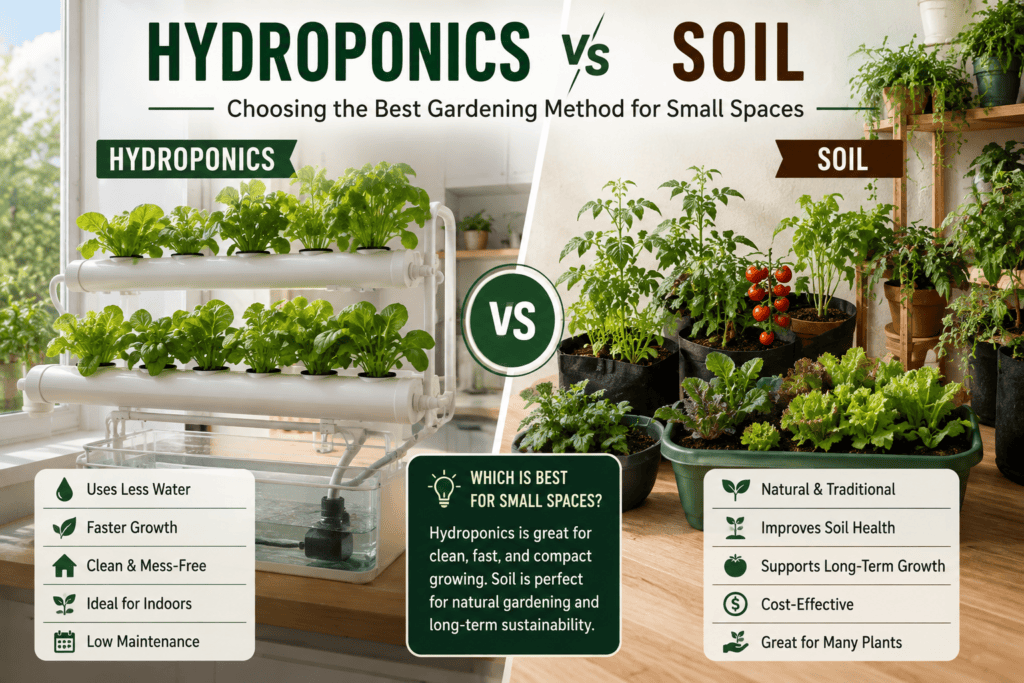
Choosing the right growing medium is the first critical decision for any small-space gardener. The debate of hydroponics versus soil takes on a different weight when your growing area is measured in inches rather than acres.
While soil offers a traditional, forgiving environment, hydroponics uses water-based nutrient solutions to bypass dirt entirely. Selecting the right method depends on how you balance physical space, budget, growth expectations, and your willingness to manage technical systems.
—
Spatial Footprint and Vertical Integration
In compact apartments or small balconies, floor space is premium real estate. Every square inch dedicated to a plant pot is space taken away from living areas.
Maximizing Verticality with Hydroponics
Hydroponics excels at vertical integration. Because plants grown in water do not need extensive root systems to search for nutrients, their roots remain compact. This allows for vertical stacking that is impossible with heavy soil.
A vertical hydroponic tower can house 20 to 80 plants in a footprint of just two square feet. These systems use a central reservoir at the base, pumping water to the top and letting it trickle down through the root zones.
Weight is another critical factor for indoor flooring and balconies. Soil becomes exceptionally heavy when wet. A 10-gallon soil container can easily weigh 80 pounds.
In contrast, hydroponic systems distribute water weight evenly, and many vertical systems use lightweight plastic channels that put far less structural strain on balcony joists.
Soil Gardening in Compact Containers
Soil gardening relies on lateral and vertical depth to support root networks. To grow successfully in soil, you need containers deep enough to prevent plants from becoming root-bound. This limits your vertical options to tiered shelving units or wall-mounted planters.
Standard tiered shelving can hold several small pots, but each pot requires its own saucer to catch drainage water, which limits air circulation and light penetration to the lower shelves.
Furthermore, soil containers are bulky. A typical five-gallon bucket takes up about 1.1 square feet of floor space and can only support a single tomato plant or three strawberry plants.
—
Financial Analysis: Setup Costs vs. Operational Expenses
The financial commitment for these two methods follows completely different trajectories. Hydroponics requires a high upfront investment with variable running costs, while soil starts cheap but incurs steady, recurring fees.
The Hydroponic Investment Curve
Starting a hydroponic garden requires specialized equipment. A basic countertop herb kit costs between $60 and $150. If you scale up to a multi-tier active system or a vertical tower, expect to spend $300 to $800 upfront. This covers the reservoir, water pump, air pump, tubing, net cups, grow media (like clay pebbles or rockwool), and initial liquid nutrients.
Operational costs are ongoing. You must factor in the electricity to run water pumps 24/7 and air pumps to oxygenate the water. If growing indoors, high-output LED grow lights are mandatory, adding to your monthly utility bill.
Liquid nutrients also must be replenished every few months. While highly efficient, these specialized mineral salts are more expensive per application than standard dry fertilizers.
Budgeting for Soil-Based Success
Soil gardening is highly accessible for tight budgets. You can get started for under $50 by purchasing fabric grow bags, plastic pots, and a few bags of high-quality organic potting mix. There are no pumps to buy, no electrical hookups required, and no complex plumbing.
However, soil is a consumable resource. Over a growing season, plants deplete the nutrients in the soil, and the structure of the potting mix breaks down, becoming compacted.
To maintain soil health, you must replace or heavily amend your soil every year with fresh compost, worm castings, and organic fertilizers. You will also need to invest in pest control solutions, as soil is a natural breeding ground for insects and fungal pathogens.
—
Growth Dynamics: Speed, Yield, and Density
How quickly you want to harvest and how much food you need to produce per square foot will heavily influence your choice.
Accelerating Harvest Cycles
Plants grown in hydroponic systems grow up to 30% to 50% faster than those grown in soil under the same conditions. In a soil environment, plant roots must actively search for nutrients and moisture, expending energy that would otherwise go toward foliage and fruit production.
In hydroponics, the roots are bathed directly in an oxygenated, nutrient-rich water solution. The plant receives everything it needs with minimal effort.
For example, loose-leaf lettuce grown hydroponically can go from seedling to harvest in 21 to 28 days. In soil, that same seed typically requires 45 to 50 days to reach maturity. This rapid turnaround allows small-space gardeners to run continuous harvest cycles throughout the year.
Lettuce Growth Timeline
Optimizing Yield per Square Inch
Because hydroponic roots do not need room to spread out laterally, you can plant crops much closer together. This high planting density drastically increases your yield per square foot.
In a traditional soil container, a single head of butterhead lettuce requires a 10-inch spacing circle. In a hydroponic NFT (Nutrient Film Technique) channel, you can space those same heads 6 inches apart.
Furthermore, because the nutrient delivery is highly controlled, every plant receives uniform feeding. This eliminates the “runt of the litter” phenomenon often seen in shared soil planters where one dominant plant hogs the nutrients and water, stunting its neighbors.
—
Maintenance and Technical Learning Curves
The daily and weekly chores associated with each method require different skills and time commitments.
The Hydroponic Technical Barrier
Hydroponics is an active, precision-based science. Because water is the sole medium, there is no buffer to protect plants from mistakes.
You must monitor two key metrics using digital meters:
- pH (Potential Hydrogen): Measures the acidity or alkalinity of the water. Most plants require a strict range of 5.5 to 6.5. If the pH drifts outside this window, the roots chemically lock up, unable to absorb nutrients even if they are present in the water.
- EC (Electrical Conductivity): Measures the concentration of dissolved mineral salts in the water. Too low, and your plants starve; too high, and you burn the roots.
You must check these levels every two to three days. Additionally, every two weeks, you must completely drain, flush, and refill the reservoir to prevent salt buildup and pathogen growth.
If a water pump fails or a power outage occurs, hydroponic roots can dry out and die within hours because there is no soil holding moisture to keep them alive.
The Intuitive Nature of Soil Gardening
Soil gardening relies on natural biology rather than digital sensors. Soil acts as a giant buffer. It holds onto nutrients and slowly releases them to the plant, meaning you do not need to worry about precise chemical balances.
Watering is intuitive. Instead of using digital meters, you use the “finger test.” Simply insert your index finger one inch into the soil. If it feels dry, you water; if it feels damp, you wait.
The primary maintenance tasks in soil are weeding, manually top-dressing with compost, and monitoring soil moisture. If you forget to water a soil pot for a day, the soil retains enough residual moisture to keep the plant hydrated, giving you a wider margin of error.
—
Environmental Control: Indoor vs. Outdoor Requirements
Your growing environment—whether a sunny balcony or a dark hallway corner—will dictate which system can actually survive.
Controlled Environment Agriculture (CEA)
Indoor hydroponics is a subset of Controlled Environment Agriculture. When you bring water-based systems indoors, you must manage the microclimate of the room.
Because hydroponic reservoirs evaporate water continuously, they can rapidly raise the humidity of a small room or closet. High humidity (above 70%) can lead to powdery mildew, root rot, and indoor mold issues. You will often need to run a small oscillating fan or a dehumidifier to keep air moving.
To get any meaningful yield indoors, you must also invest in artificial lighting. While leafy greens can get by on lower-wattage shop lights, fruiting plants like tomatoes or peppers require full-spectrum LED grow lights run for 12 to 16 hours a day.
Adapting to Natural Light Cycles
Soil gardening is highly adaptable to outdoor spaces like balconies, patios, and windowsills. Soil naturally buffers temperature swings, protecting plant roots from the midday heat that can easily overheat small hydroponic reservoirs.
By placing soil pots outdoors, you harness natural sunlight, eliminating the need for expensive grow lights and reducing your carbon footprint.
However, outdoor soil gardening means dealing with natural elements. Rain can wash away nutrients from pots, requiring you to reapply fertilizers. You are also at the mercy of seasonal pests like aphids, spider mites, and fungus gnats, which find soil to be an ideal nesting ground.
—
FAQ
Is hydroponics better than soil for small apartment gardening?
Hydroponics is cleaner and more space-efficient for indoor apartments because it eliminates the mess of spilled dirt, potting bags, and soil-borne pests like fungus gnats. However, soil is much simpler to set up and does not require constant monitoring of water chemistry or electrical outlets.
What are the ongoing costs of hydroponic kits compared to soil?
Hydroponic kits require ongoing purchases of liquid nutrient concentrates, pH adjusters, and electricity to run pumps and grow lights. Soil gardening costs include buying fresh compost or potting mix annually, organic fertilizers, and occasionally replacement pots or pest treatments.
Do vegetables grown in hydroponics taste different than soil-grown produce?
Flavor is determined by genetics, light, and nutrient availability. While some argue that soil-grown crops have a more complex flavor due to diverse soil microbes, hydroponic crops can taste identical or even sweeter if the nutrient solution is perfectly balanced and the plants receive optimal light.
How much space do I need for a basic hydroponic setup?
A basic countertop hydroponic unit occupies a footprint of about 12 by 6 inches—roughly the size of a standard loaf of bread. Larger vertical towers require a circular footprint of about 2 feet in diameter and can stand 4 to 6 feet tall.
Which system is easier for a beginner to maintain?
Soil is significantly easier for beginners. It acts as a natural buffer against watering and fertilizing mistakes, whereas hydroponics requires a steep learning curve to master pH balancing, nutrient dosing, and system maintenance.