Crafting the Ideal Potting Soil for Containers: A Guide to Optimal Drainage
Understanding Drainage: Why Container Plants Need It
Container gardening isolates a plant’s root system from the natural ecosystem of the ground. In a garden bed, gravity and vast soil volume pull excess water away from roots. In a pot, water behaves differently, often pooling at the bottom due to the perched water table effect. This physical limitation makes choosing the right potting soil for containers a critical factor in plant health.
When soil remains saturated, water fills the tiny pore spaces that should hold oxygen. This creates an anaerobic (oxygen-depleted) environment. Roots require oxygen to perform cellular respiration, which powers the absorption of water and nutrients. Without oxygen, root cells suffocate and die.
Once the root system begins to decay, opportunistic fungi like Pythium, Phytophthora, and Rhizoctonia take hold, causing root rot. The damaged roots can no longer transport water or essential minerals up to the rest of the plant.
The above-ground symptoms of this underground crisis are often misleading. A plant suffering from poor drainage will wilt, even though the soil is wet, because its damaged roots cannot absorb moisture. You will also notice leaves turning pale yellow, starting with the lower foliage. Growth stalls, stems become mushy near the soil line, and eventually, the plant dies. Proper drainage ensures that water moves through the root zone quickly, drawing fresh oxygen down into the soil behind it.
Essential Amendments for Superior Drainage
Raw organic matter like peat or compost holds too much water on its own. To keep the soil structure open and airy, you must mix in coarse, inorganic amendments.
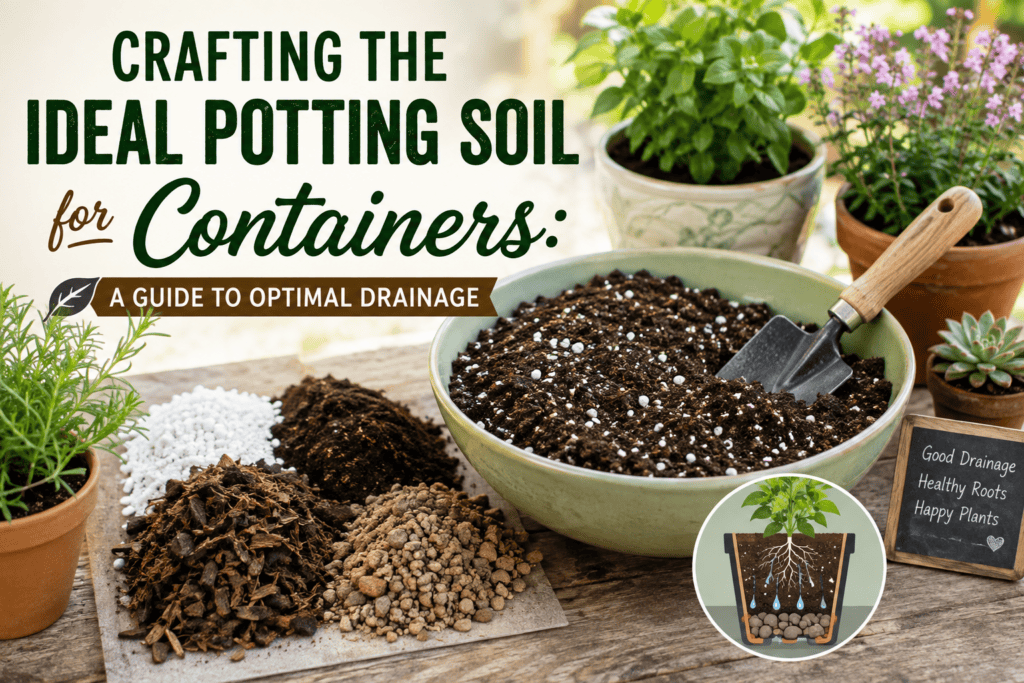
- Perlite: This is a lightweight, volcanic glass that is heated until it expands like popcorn. The resulting white particles are highly porous and do not absorb water internally; instead, they trap air on their irregular outer surfaces. Perlite is the industry standard for creating large pore spaces that allow water to flush through rapidly.
- Vermiculite: Formed from hydrated laminar minerals (mica) that are expanded with heat, vermiculite has a sponge-like structure. While it improves soil aeration, it also holds significant moisture and nutrients within its layers.
- Coarse Sand: You must use coarse, horticultural-grade sand. Avoid fine play sand or beach sand, which have rounded, tiny grains that pack together like concrete when wet. Coarse sand adds weight to stabilize top-heavy pots and creates small, sharp channels for water movement.
- Bark Fines: Typically made from milled pine or fir bark, these small wood pieces create stable, long-lasting air pockets. Bark fines break down very slowly, providing structure for several seasons while adding mild acidity and organic matter to the mix.
- Pumice and Calcined Clay: Pumice is a heavy, porous volcanic rock that behaves similarly to perlite but does not float to the top of the pot during watering. Calcined clay (fired clay granules) absorbs water while maintaining a hard, porous structure that resists compaction.
Perlite vs. Vermiculite: Choosing the Right Amendment
While both are expanded minerals, they serve different purposes in a container mix.
- Choose perlite for plants that require dry conditions between waterings, such as succulents, cacti, herbs, and most indoor houseplants. Perlite sheds water quickly and maximizes oxygen levels around the roots.
- Choose vermiculite for moisture-loving plants like ferns, tropical foliage, and seed-starting mixes. Vermiculite keeps the soil consistently damp while still preventing the compaction that causes root rot.
Sourcing Quality Drainage Materials
When buying amendments, look for products specifically labeled for horticultural use. Non-horticultural materials can introduce toxins, salts, or weed seeds.
Buy coarse-grade perlite (often labeled as medium or coarse) rather than fine-grade, which can clog soil pores. If you source bark fines, ensure they are aged or composted; fresh wood chips will rob the soil of nitrogen as they begin to decompose.
Ingredients to Limit or Avoid in Container Potting Soil
What works in a backyard garden bed will fail in a container. Understanding what to leave out of your pots is just as important as knowing what to include.
- Garden Soil: Never scoop dirt from your yard to fill a pot. Natural garden soil contains high levels of silt and clay. When confined to a container, these fine particles pack tightly together, eliminating all air space. Yard soil also introduces weed seeds, insect larvae, and soil-borne pathogens directly to your vulnerable container plants.
- Topsoil and Clay: Commercial topsoil is often just scraped earth from construction sites. It lacks the structure needed for pots. Clay soils are composed of microscopic, flat particles that stick together, trapping water and suffocating roots.
- Excessive Peat Moss: Peat moss is excellent for holding moisture, but it has a major drawback. If it dries out completely, it becomes hydrophobic. Water will run down the sides of the pot, leaving the root ball bone-dry. Over time, pure peat moss degrades and compacts into a dense, airless brick.
- Excessive Compost: While compost is rich in nutrients and beneficial microbes, it is too heavy and dense to use as a primary container ingredient. In a closed pot, compost continues to break down, sinking and compacting. Keep compost to a small percentage of your overall mix to avoid waterlogging and nutrient imbalances.
Formulating Your Own Well-Draining Potting Mix
Making your own potting soil for containers allows you to control the quality of the ingredients and tailor the drainage properties to your specific plants.
Basic Ratios for Common Container Plants
For a reliable, all-purpose base mix, use these proportions by volume:
- 5 parts peat moss or coconut coir (for moisture retention)
- 3 parts coarse perlite (for drainage)
- 2 parts compost or aged bark fines (for nutrients and structure)
Adjusting Mixes for Specific Plant Needs
You can modify the base recipe to suit different plant groups:
- Succulents and Cacti: These desert plants need rapid drainage and very little water retention. Mix 2 parts coarse sand, 2 parts perlite or pumice, 1 part coco coir, and 1 part bark fines.
- General Annuals and Perennials: These plants need a balance of moisture and air. Use the standard base mix (5:3:2 ratio). If growing in a hot, windy location where pots dry out quickly, increase the coir or peat portion slightly.
- Heavy Feeders (Vegetables and Tomatoes): Vegetables need constant access to nutrients but still require excellent drainage. Mix 4 parts peat or coir, 3 parts compost, 2 parts perlite, and 1 part bark fines. Add a handful of slow-release organic fertilizer pellets to the mix.
Mixing Your Ingredients Safely
Dry peat moss and perlite release a fine dust that can irritate your lungs. Always wear a dust mask and work in a well-ventilated outdoor area.
- Dump your dry ingredients into a large wheelbarrow, plastic tub, or onto a clean tarp.
- Lightly mist the ingredients with a garden hose to settle the dust.
- Use a shovel or your hands to blend the materials until the color and texture are completely uniform.
- Slowly add water to the dry mix and stir. The ideal consistency is reached when you squeeze a handful of soil and it forms a loose ball that crumbles easily when poked.
Assessing and Resolving Drainage Problems
Even with careful planning, drainage issues can arise. Regular observation helps you catch problems before they ruin your plants.
Testing Soil Drainage
To test your potting soil, fill a container with the dry mix and press it down gently (do not pack it). Pour water over the surface.
The water should sink into the soil immediately, rather than pooling on top. Within 10 to 15 seconds, water should begin dripping steadily from the drainage holes at the bottom of the pot. If the water pools on top for more than a minute, or takes hours to drip out of the bottom, your mix is too dense.
Identifying Signs of Poor Drainage
Look for these warning signs in your container garden:
- The soil surface greening with moss or algae.
- Fungus gnats hovering around the damp soil.
- A sour, swamp-like odor coming from the pot.
- Leaves dropping off the plant while still green.
Solutions for Existing Plants
If you discover a plant is suffering in waterlogged soil, take immediate action:
- Repot: Gently slide the plant out of its pot. Inspect the roots; cut away any black, mushy, or foul-smelling roots with sterilized shears. Gently shake away the old, compacted soil and repot the plant in a clean container using a fresh, well-draining mix.
- Adjust Watering: Let the soil dry out significantly between waterings. Use a wooden chopstick inserted deep into the pot to check for moisture before adding water.
- Fix the Container: Ensure the pot has functional drainage holes. If it does not, drill holes in the bottom using a masonry or plastic-rated drill bit. Never use pots without drainage holes for outdoor plants. If you use decorative “cachepots” without holes, keep the plant in a plastic nursery liner inside the decorative pot, and empty any standing water from the outer pot after watering. Avoid placing gravel at the bottom of a pot without holes; this does not create drainage, but rather raises the water table closer to the plant’s roots.
Frequently Asked Questions
What is the best potting soil for containers?
There is no single “best” commercial potting soil, as different plants have different water and nutrient requirements. However, the ideal potting soil for containers is a lightweight, soilless mix that contains a balance of organic matter for water retention (such as coco coir or peat moss) and coarse inorganic amendments (such as perlite or pumice) to ensure rapid drainage and aeration.
Can I make my own potting soil for containers?
Yes, making your own potting soil is highly recommended. It is cost-effective, allows you to customize the drainage level for specific plants, and ensures you are using high-quality, weed-free ingredients. A simple DIY recipe is to mix equal parts coco coir, coarse perlite, and high-quality compost.
What can I add to potting soil to improve drainage?
To improve drainage in a dense potting soil, mix in coarse amendments. The most effective options are perlite, pumice, horticultural-grade coarse sand, and aged pine bark fines. These materials create large air pockets that allow excess water to flow out of the pot quickly.
How do I know if my potting soil has good drainage?
Good drainage is characterized by water moving quickly through the pot. When you water, the liquid should absorb into the surface immediately and begin running out of the bottom drainage holes within 10 to 30 seconds. The soil should feel damp but not muddy or swampy after watering.
Is perlite or vermiculite better for drainage?
Perlite is superior for drainage and aeration because it does not absorb water and creates large air pockets. Vermiculite is better for plants that need consistent moisture, as it holds water and nutrients while still keeping the soil from compacting. Use perlite for succulents and dry-loving plants, and vermiculite for moisture-loving plants.
Can I use garden soil in pots?
No, you should never use native garden soil in containers. Garden soil contains fine clay particles that compact tightly within the confines of a pot, suffocating plant roots. It also lacks adequate drainage and can introduce weeds, pests, and fungal diseases to your containers.
What is the difference between potting soil and potting mix?
The key difference is the presence of actual soil. “Potting soil” may contain real soil or heavy organic matter, which can compact easily. “Potting mix” is a sterile, soilless blend of ingredients like peat moss, coco coir, perlite, and vermiculite. Soilless potting mixes are much lighter, drain better, and are safer for container plants.