How to Manage Indoor Plant Humidity in Small Spaces
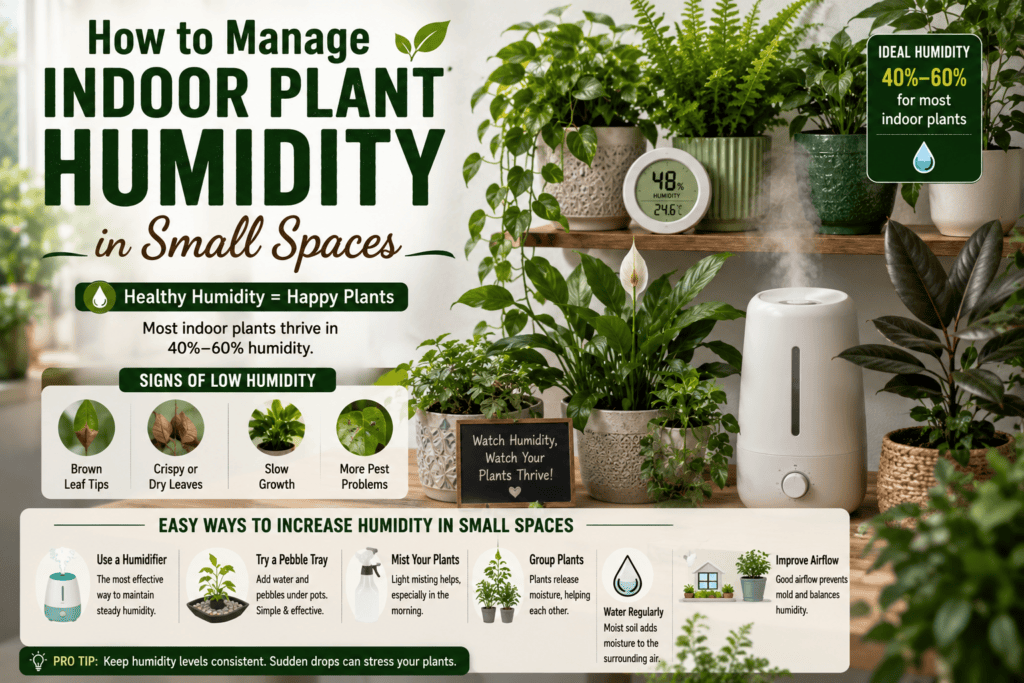
Managing indoor plant humidity is one of the most challenging aspects of growing tropical flora in tight quarters. In compact apartments, drafty windows and central heating create rapid shifts in air moisture. Regulating this invisible variable is essential for keeping your indoor garden vibrant and disease-free.
Understanding Humidity Requirements for Tropical Plants
Tropical understory plants are biologically adapted to constant, high atmospheric moisture. Indoors, they must adapt to air that is often far drier than their native habitats.
During winter, forced-air heating systems pose a major threat. They warm cold outdoor air, which drops relative humidity below 20%—comparable to average desert levels of 10% to 30%. This dry air acts like a sponge, pulling moisture out of leaves through transpiration faster than the roots can absorb it.
When plants experience chronic humidity stress, they display clear physiological symptoms:
- Brown, crispy leaf tips and margins: Moisture is evaporating from leaf cells faster than it can be replaced.
- Curling or puckering leaves: Plants curl inward to reduce the surface area exposed to dry air currents.
- Stunted new growth: Emerging leaves get stuck in their sheaths, unfurl deformed, or remain undersized.
- Premature leaf drop: The plant sheds older foliage to prioritize water conservation for its core stem and roots.
Aim for a humidity range of 50% to 60% for common indoor tropicals like Philodendrons, Monstera deliciosa, and Pothos. Sensitive species, such as Calatheas, Fittonias, and certain Anthuriums, require levels closer to 70% or higher to prevent leaf damage.
Measuring Ambient Humidity with Hygrometers
You cannot manage what you do not measure. Relying on human perception to judge air moisture is unreliable. A dedicated hygrometer is an essential tool for any small-space gardener.
- Analog hygrometers: These use a coil or synthetic hair that expands or contracts. They do not require batteries but need frequent calibration and are often accurate only within 10%.
- Digital hygrometers: These use electronic sensors to measure electrical resistance or capacitance changes. They are highly accurate (usually within 2% to 3%), provide instant readings, and often display daily high and low records. Many models are small enough to fit on tight shelves.
For accurate readings, place your hygrometer directly within the plant canopy at the same height as the middle foliage. Positioning a sensor across the room, near a drafty window, or next to a heating vent will give you a false reading of the actual microclimate.
Record daily humidity levels for one week during seasonal transitions—specifically in late autumn when the heater turns on, and in late spring when you switch to air conditioning. This baseline helps you anticipate dry spells and adjust your setup before plants show signs of stress.
Group Planting Strategies for Localized Moisture
In small apartments, running multiple mechanical humidifiers is often impractical due to space and outlet constraints. Grouping your plants together is a natural, space-saving alternative that utilizes transpiration.
Plants constantly release water vapor through microscopic leaf pores called stomata. When you cluster plants closely, this moisture becomes trapped within the shared canopy, creating a localized microclimate with elevated relative humidity.
Group compatible species with similar moisture and light requirements, such as Calatheas, Ferns, and Marantas. Do not mix desert cacti or succulents into these groupings, as the elevated moisture can trigger rot.
To optimize a small footprint, use tiered decorative stands or plant ladders. Varying the height of your plants serves two purposes:
- It creates a denser, multi-layered canopy that traps moisture more effectively.
- It improves air circulation around the lower stems and pots, preventing stagnant air that invites pests and mold.
DIY Pebble Tray Construction and Maintenance
Pebble trays are a classic, low-tech method for boosting localized humidity directly beneath individual plants. They are particularly useful on narrow windowsills, mantels, or small side tables.
To construct a pebble tray, gather:
- A shallow, waterproof tray or saucer (plastic, glazed ceramic, or metal) at least two to three inches wider than the base of your plant pot.
- Clean, non-porous stones such as river pebbles, pea gravel, or decorative glass gems. Avoid porous stones like limestone, which degrade and alter water chemistry.
- Clean water.
Fill the tray with a one- to two-inch layer of pebbles. Pour water into the tray, ensuring the water level stops just below the top surface of the stones.
The bottom of the pot must remain completely dry. If the pot sits directly in water, capillary action will draw moisture upward, leading to waterlogged soil and root rot.
As the water evaporates, it rises directly around the foliage. Clean the trays and pebbles once a week to prevent issues. Empty the water, rinse the pebbles in hot water to remove dust, algae, or mineral buildup, and wipe down the tray before refilling.
Selecting Humidifiers for Small Indoor Spaces
When natural methods are not enough to combat dry winter air, a dedicated room humidifier is the most reliable solution.
| Humidifier Type | How It Works | Pros for Small Spaces | Cons for Small Spaces | | :— | :— | :— | :— | | Ultrasonic | Uses a vibrating diaphragm to create a cool, micro-fine mist. | Extremely quiet; energy-efficient; compact designs. | Can leave a fine white mineral dust on surfaces if tap water is used. | | Evaporative | Uses a fan to blow air through a wet wick filter. | Self-regulating (cannot over-saturate air); no mineral dust. | Noisy fan; requires regular filter replacements; bulkier units. |
For small rooms, select a compact ultrasonic unit with an adjustable output dial and a built-in humidistat. Set your target humidity (such as 55%), and the unit will cycle on and off to maintain it. This prevents over-saturation, which can cause condensation on cold walls and windows, leading to mold.
Position the humidifier on an elevated surface like a shelf or stool so the mist evaporates before hitting the floor. Aim the nozzle away from walls, wooden furniture, and electrical outlets. Do not aim the cool mist directly at your plants’ leaves; constant wetness prevents normal transpiration and invites fungal spores.
Managing Airflow to Prevent Fungal Issues
High humidity combined with stagnant air is a recipe for disease. In small spaces with closed doors and windows, moisture can easily trap fungal pathogens against plant tissues.
You must balance high humidity with consistent, gentle airflow to dry wet leaf surfaces, assist in gas exchange, and strengthen plant stems.
Place a small, low-wattage oscillating fan in the room. Do not point the fan directly at your plants, as constant wind causes rapid moisture loss and windburn. Instead, point the fan at an adjacent wall or ceiling to create a gentle, indirect circular air current.
Regularly inspect your plants for early signs of pathogens:
- Powdery mildew: A white, dusty coating on leaf tops.
- Grey mold (Botrytis): Fuzzy grey patches on decaying leaves or flowers.
- Sooty mold: Dark spots that appear on sticky pest residues.
- Fungus gnats: Tiny black flies that breed in constantly wet topsoil.
If you notice any of these signs, isolate the affected plant immediately. Prune away damaged foliage with sterile shears, reduce your humidity levels slightly, and increase fan speed to improve air circulation.
***
FAQ
How do I measure humidity for indoor plants?
Use a small digital hygrometer. Place the device directly within your plants’ canopy at leaf level, rather than across the room or on the floor, to measure the actual microclimate surrounding the foliage.
Do pebble trays actually increase humidity?
Yes, but only in the immediate space directly above and around the tray. They do not have enough output to raise the relative humidity of an entire room. They are highly effective for individual, small plants but should be combined with other methods for larger collections.
What are the best indoor plants for high humidity?
Calatheas, Marantas (Prayer Plants), Boston Ferns, Maidenhair Ferns, Alocasias, Anthuriums, and Orchids. These species naturally grow in damp rainforest understories and require moist air to thrive.
Can indoor plants get too much humidity?
Yes. If relative humidity consistently exceeds 70% to 80% without adequate airflow, plants are at high risk for fungal infections, root rot, and leaf spot. High humidity also slows down transpiration, preventing the plant from drawing up essential nutrients.
How does central heating affect tropical plant health?
Central heating warms cold outdoor air, which sharply decreases its relative humidity to desert-like levels of 15% to 20%. This dry air rapidly strips moisture from tropical leaves, leading to crispy brown tips, curling margins, and dehydration.