Best Grow Lights for Indoor Plants in Small Spaces
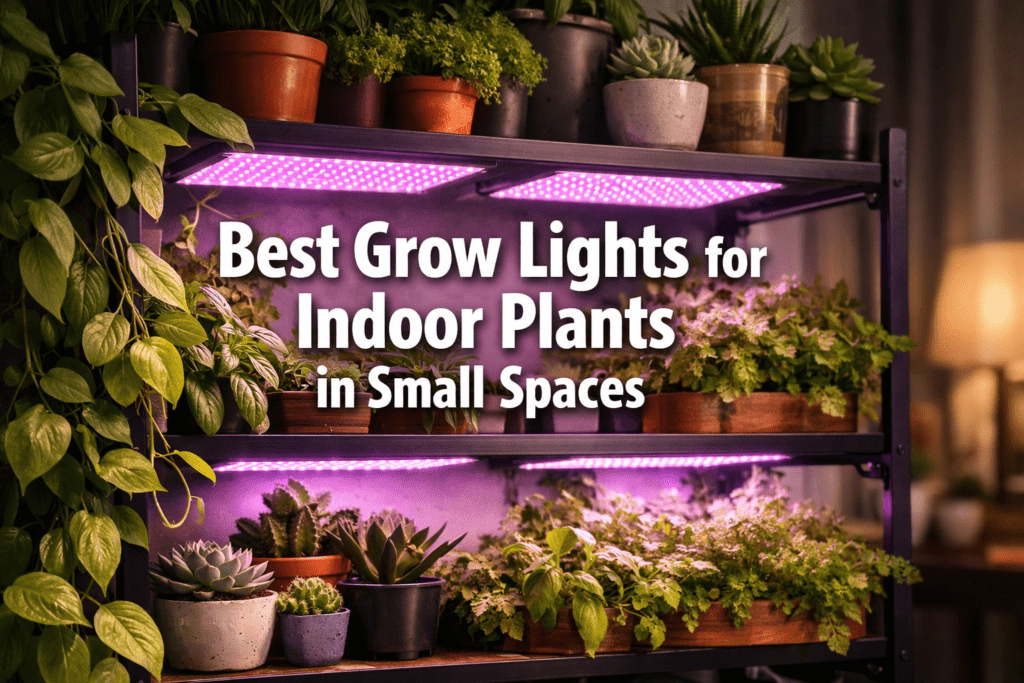
Quick Answer: The best grow lights for indoor plants in small spaces are compact LED fixtures with full-spectrum output, ideally in the 20–40 watt range for shelves and countertops. Look for adjustable gooseneck or clip-on designs, a color temperature between 3000K and 6500K, and a built-in timer. LED grow lights last up to five times longer than fluorescent alternatives and use significantly less energy [3].
Key Takeaways
- LED grow lights are the top choice for small spaces: energy-efficient, long-lasting, and low heat output [3]
- Most houseplants need roughly 20–25 watts per square foot, while herb gardens need more light intensity [3]
- Full-spectrum bulbs (balanced blue and red wavelengths) work best for tropical houseplants and edible herbs [3]
- Herb plants specifically need more than 1,000 lumens per square foot to grow productively [3]
- Compact formats — clip-on lamps, tabletop kits, and under-shelf LED strips — fit small apartments and shelves best [4]
- A built-in timer is one of the most underrated features; most plants need 12–16 hours of light daily
- Aesthetics matter in living spaces: stylish options like the Mother PlantSpectrum light blend into home décor [5]
- Avoid placing grow lights too far from plants — most compact LEDs work best within 6–18 inches of the canopy
What Makes a Grow Light “Best” for Small Spaces?
The best grow lights for indoor plants in small spaces balance light output, physical footprint, and ease of use. In a compact apartment or on a crowded shelf, a light that’s too bulky or too hot creates more problems than it solves.
Here’s what to prioritize when evaluating any grow light for a tight space:
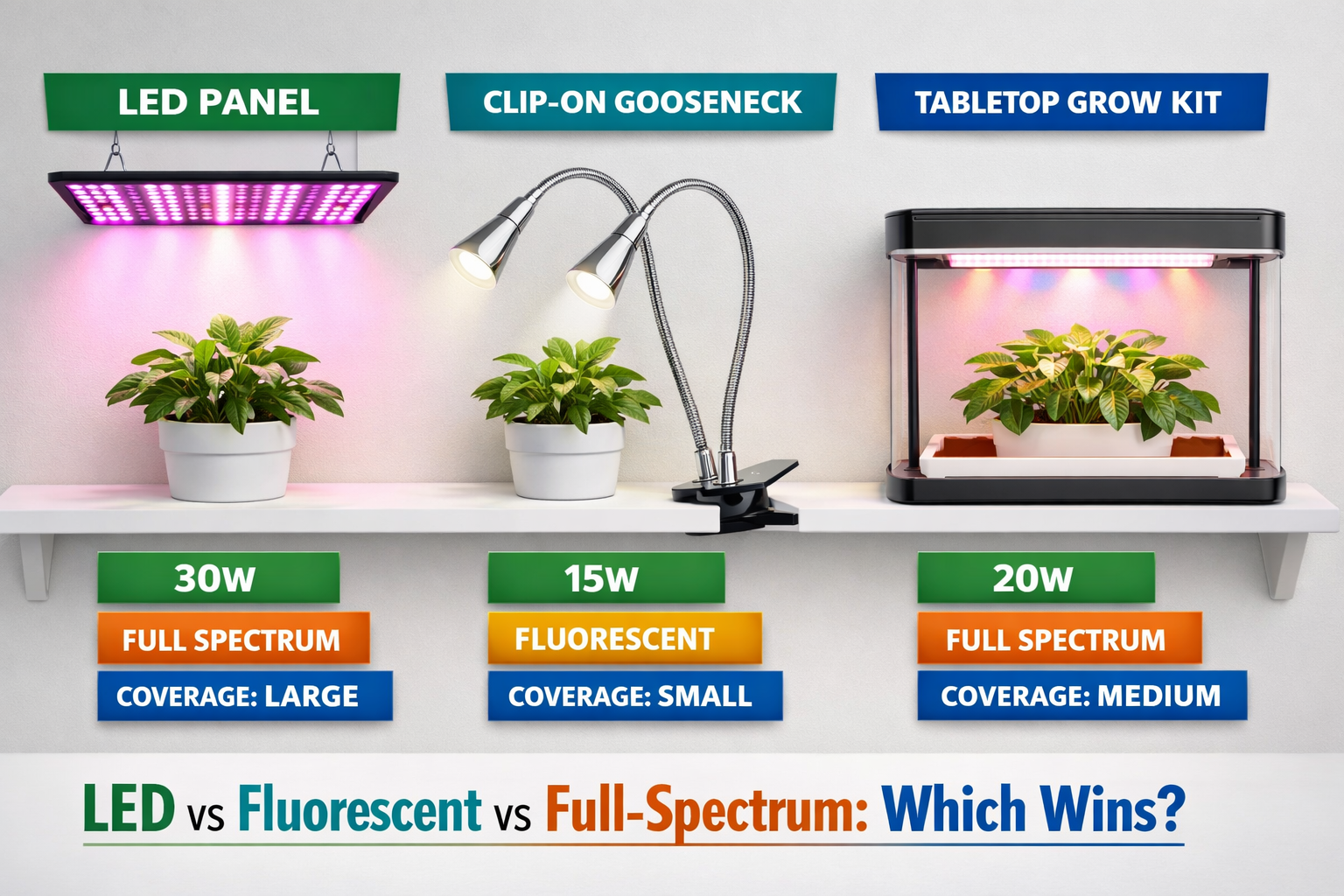
- Form factor: Clip-on, gooseneck, or under-shelf strip lights take up minimal room
- Wattage: 10–40 watts covers most small setups; higher wattage is overkill for a single shelf
- Spectrum: Full-spectrum LEDs (covering blue, red, and some green wavelengths) support all growth stages [3]
- Heat output: LEDs run cool, which matters when lights are close to leaves or in enclosed spaces
- Timer function: Automates the 12–16 hour light cycle most plants need
- Cord length and mounting options: Flexibility matters in small rooms
“Choose X if…” logic: Choose a clip-on gooseneck lamp if you have a single plant or small pot. Choose an under-shelf LED strip if you’re lighting a row of herbs on a kitchen shelf. Choose a tabletop grow kit if you’re a beginner who wants everything in one package.
LED vs. Fluorescent vs. Incandescent: Which Light Type Wins?
For small indoor spaces, LED grow lights are the clear winner. They last up to five times longer than other bulb types while consuming less electricity and producing less heat [3]. Fluorescent lights (especially T5 tubes) are a decent budget option but are bulkier and less efficient. Incandescent bulbs are not recommended — they produce too much heat and the wrong light spectrum for plant growth.
| Light Type | Lifespan | Energy Use | Heat Output | Best For |
|---|---|---|---|---|
| LED | Very long | Low | Low | All small-space setups |
| Fluorescent (T5) | Moderate | Medium | Medium | Seedlings, low-budget setups |
| CFL | Moderate | Medium | Low-medium | Single plants, tight budgets |
| Incandescent | Short | High | High | Not recommended |
Common mistake: Many beginners buy incandescent “plant bulbs” from hardware stores. These produce mostly heat and red-heavy light, which leads to leggy, stressed plants. Stick with LEDs or T5 fluorescents.
How Much Light Do Indoor Plants Actually Need?
Most houseplants need approximately 20–25 watts per square foot, or around 500 lumens per square foot, for healthy growth [3]. Herb plants are more demanding — they need full-spectrum bulbs delivering more than 1,000 lumens per square foot to grow productively [3].
Here’s a practical breakdown by plant type:
- Low-light houseplants (pothos, snake plant, ZZ plant): 10–15 watts per sq ft; 200–400 lumens per sq ft. See our guide to low light indoor plants for compatible varieties.
- Tropical houseplants (peace lily, philodendron, ferns): 20–25 watts per sq ft; 400–600 lumens per sq ft [3]
- Herbs (basil, mint, cilantro): 30–40 watts per sq ft; 1,000+ lumens per sq ft [3]
- Vegetables and fruiting plants: 40–50 watts per sq ft; 1,500+ lumens per sq ft. Our indoor herb garden setup guide covers this in more detail.
Distance matters too. Most compact LED grow lights perform best when positioned 6–18 inches above the plant canopy. Too far away and plants stretch toward the light (etiolation). Too close and leaf tips may bleach or burn.
Top Grow Light Picks for Small Indoor Spaces in 2026
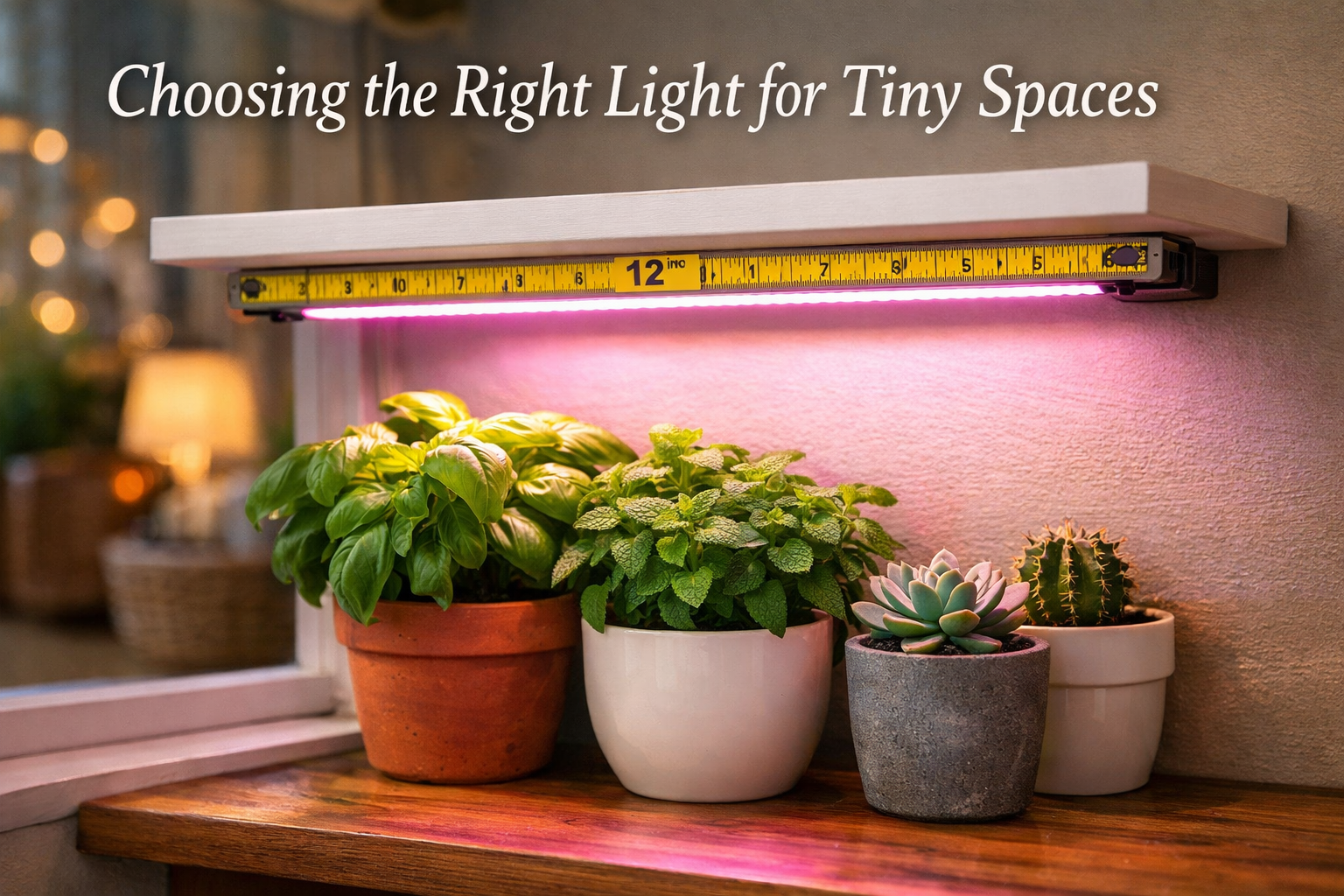
These are the best grow lights for indoor plants in small spaces across different budgets and use cases. I’ve focused on compact, practical options rather than large commercial panels.
Best for Beginners: Oslo Tabletop Grow Kit
The Oslo Tabletop Grow Kit is recommended as the top option for brand new gardeners with small spaces [4]. It comes with everything needed to start — light, planter, and growing medium — so there’s no guesswork. Ideal for a kitchen counter or desk.
Best for Houseplants: Spider Farmer SF600 LED Grow Light
The Spider Farmer SF600 is identified as one of the best grow lights specifically for houseplants [1]. It delivers full-spectrum output in a slim, low-profile panel that works well mounted under shelves or above a plant stand.
Best Desktop Option: Agrobrite Desktop Plant Lamp
The Agrobrite Desktop Plant Lamp is a compact, attractive grow light built for pampered houseplants on desks and shelves [4]. Its adjustable arm and small footprint make it easy to position precisely over a single plant or a small cluster.
Best for Aesthetics: Mother PlantSpectrum Grow Light
If the light needs to look good in a living room or bedroom, the Mother PlantSpectrum is one of the most visually attractive grow light options currently available [5]. It functions well and doesn’t look like a piece of lab equipment.
Best Budget Strip Light: Under-Shelf LED Grow Strips
Generic full-spectrum LED strips (look for 3000K–6500K color temperature, at least 30W per meter) are the most affordable way to light a full shelf of plants. They’re especially useful in kitchens for herbs. Check out indoor gardening on a budget for more cost-saving tips.
What Features Should You Look for When Buying?
When shopping for the best grow lights for indoor plants in small spaces, these are the features worth paying attention to — and the ones you can safely skip.
Features worth paying for:
- Full-spectrum output (covers blue 400–500nm and red 600–700nm wavelengths) [3]
- Built-in timer or compatibility with a plug-in timer
- Adjustable height or flexible gooseneck arm
- Low heat emission (especially important in enclosed shelving units)
- Dimmable output for plants with different light needs
Features you can skip in small setups:
- High-wattage panels (200W+ is overkill for a single shelf)
- Fans or cooling systems (unnecessary for small LED fixtures)
- Proprietary app controls (adds cost without meaningful benefit for most home growers)
If you’re also thinking about the right containers to pair with your grow light setup, our guide to the best pots for indoor plants is a helpful companion read.
Common Mistakes to Avoid With Grow Lights in Small Spaces
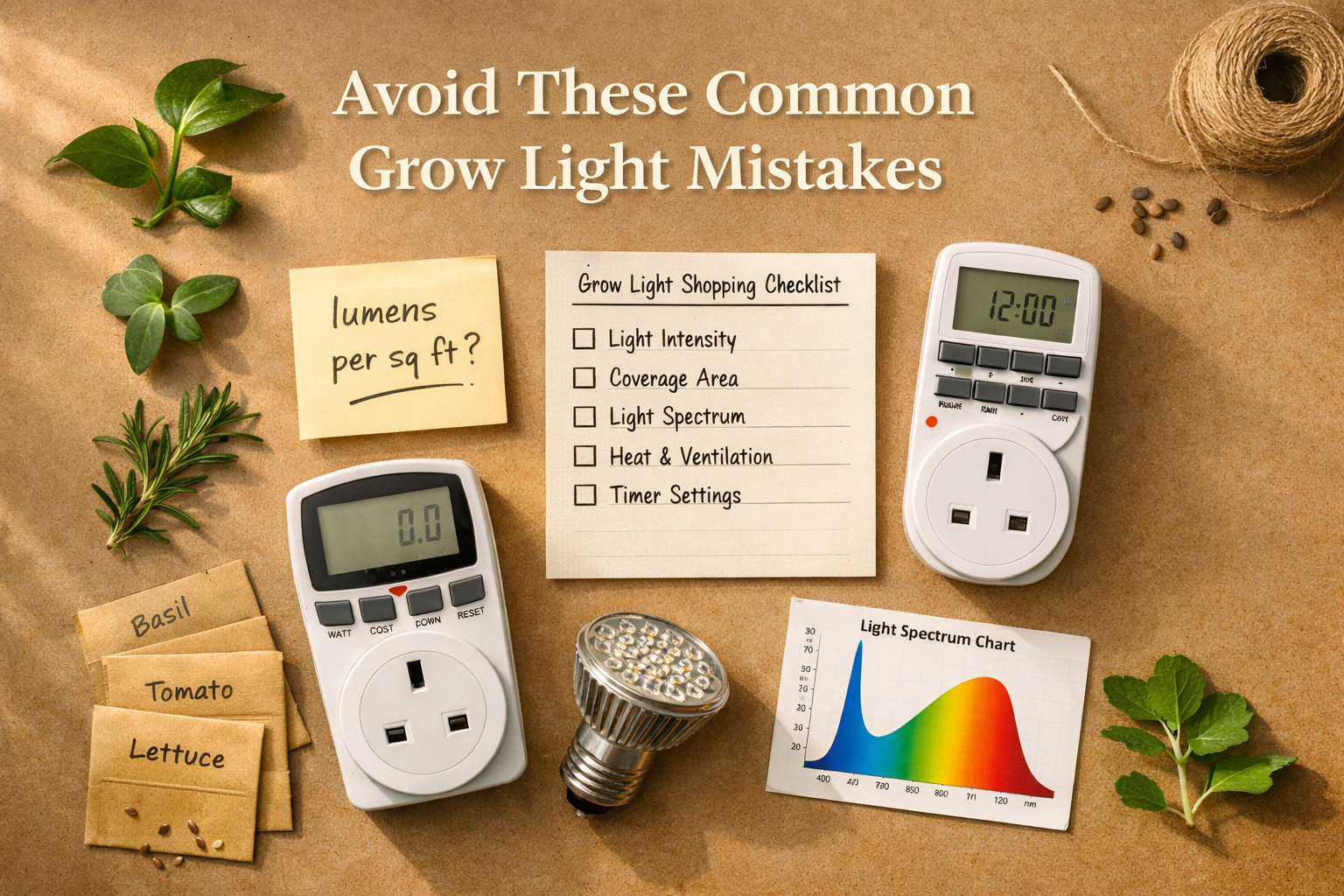
Even a great grow light won’t help if it’s used incorrectly. These are the mistakes I see most often with compact indoor setups.
1. Leaving lights on 24 hours a day
Plants need a dark period for respiration and rest. Running grow lights continuously stresses most plants. Stick to 12–16 hours on, 8–12 hours off.
2. Placing the light too far away
A 20W LED positioned 3 feet above a plant delivers a fraction of the light it would at 12 inches. Check the manufacturer’s recommended hanging distance and use it.
3. Using the wrong spectrum for the plant type
Blue-heavy light (5000K–6500K) supports leafy, vegetative growth. Red-heavy light (2700K–3000K) encourages flowering and fruiting. Full-spectrum lights (3000K–6500K) work for most situations [3].
4. Ignoring the light needs of specific plants
Some plants thrive under grow lights; others don’t need them at all. If you’re growing plants that grow without sunlight, a low-intensity grow light may be all you need.
5. Not accounting for heat in enclosed spaces
Even low-heat LEDs can raise temperatures in a closed cabinet or grow tent. Check temperatures near the plant canopy and ventilate if needed.
For a broader look at what goes wrong in indoor setups, see our indoor gardening mistakes guide.
Can Regular Ceiling Lights Replace Grow Lights?
Standard ceiling fluorescent lights can support some low-light plants but generally don’t provide enough intensity or the right spectrum for most houseplants or herbs. Our detailed breakdown on whether plants can survive with only ceiling fluorescent lights covers this question thoroughly. The short answer: for herbs, vegetables, or light-hungry tropicals, a dedicated grow light is necessary.
FAQ: Best Grow Lights for Indoor Plants in Small Spaces
Q: How many hours a day should I run a grow light?
Most houseplants need 12–14 hours of grow light per day. Herbs and vegetables do best with 14–16 hours. Always include a dark period of at least 8 hours.
Q: Are LED grow lights safe to leave on overnight?
Yes, LED grow lights are generally safe to leave on, but plants benefit from a dark period. Use a timer rather than running them overnight continuously.
Q: What wattage do I need for a small shelf of herbs?
For a standard 2-foot kitchen shelf with 4–6 herb pots, a 30–45W full-spectrum LED is usually sufficient. Herbs need more than 1,000 lumens per square foot [3].
Q: Do grow lights raise my electricity bill significantly?
A 20–40W LED grow light running 14 hours a day uses roughly 0.28–0.56 kWh per day. At average US electricity rates (around $0.16/kWh as of 2024), that’s under $1 per month per light.
Q: Can I use a grow light for succulents?
Yes. Succulents do well under full-spectrum LEDs at moderate intensity (around 500–1,000 lumens per square foot). Keep the light 12–18 inches away to avoid bleaching.
Q: What’s the difference between a grow light and a regular LED bulb?
Regular LED bulbs are optimized for human vision (mostly white light). Grow lights are tuned to the wavelengths plants use for photosynthesis, particularly blue (400–500nm) and red (600–700nm) [3].
Q: Do grow lights work for flowering plants?
Yes. For flowering, choose a light with more red spectrum output (2700K–3000K range) or a full-spectrum light that covers both blue and red wavelengths.
Q: Is a grow light necessary if my apartment gets some natural light?
Not always. If your space gets 4–6 hours of direct sun, many houseplants will manage. But for north-facing apartments or during winter months, a supplemental grow light makes a real difference.
Conclusion: Your Next Steps
Finding the best grow lights for indoor plants in small spaces comes down to three decisions: light type (LED wins), form factor (match it to your shelf or desk), and spectrum (full-spectrum for most plants, higher intensity for herbs).
Here’s a simple action plan:
- Measure your space — note the square footage of your growing area and the distance from the light mounting point to your plants
- Identify your plants’ light needs — low-light houseplants vs. herbs vs. vegetables have very different requirements
- Set a budget — quality LED grow lights start around $20–$30 for single-plant clip-ons and go up from there
- Add a timer — this is the single easiest way to improve your results without spending more on the light itself
- Start with one shelf or one plant before scaling up
For more help building out your indoor growing setup, explore our guides on indoor gardening without sunlight and small space garden hacks.
References
[1] Best Grow Lights For Indoor Plants – https://www.spider-farmer.com/blog/best-grow-lights-for-indoor-plants/
[3] The Best Grow Lights For Indoor Plants – https://eartheasy.com/blogs/grow/the-best-grow-lights-for-indoor-plants
[4] Best Grow Lights Small Spaces 9683 – https://www.gardeners.com/blogs/techniques-tools-articles/best-grow-lights-small-spaces-9683
[5] Stylish Grow Lights A88a527e 8b21d1be – https://www.dwell.com/article/stylish-grow-lights-a88a527e-8b21d1be