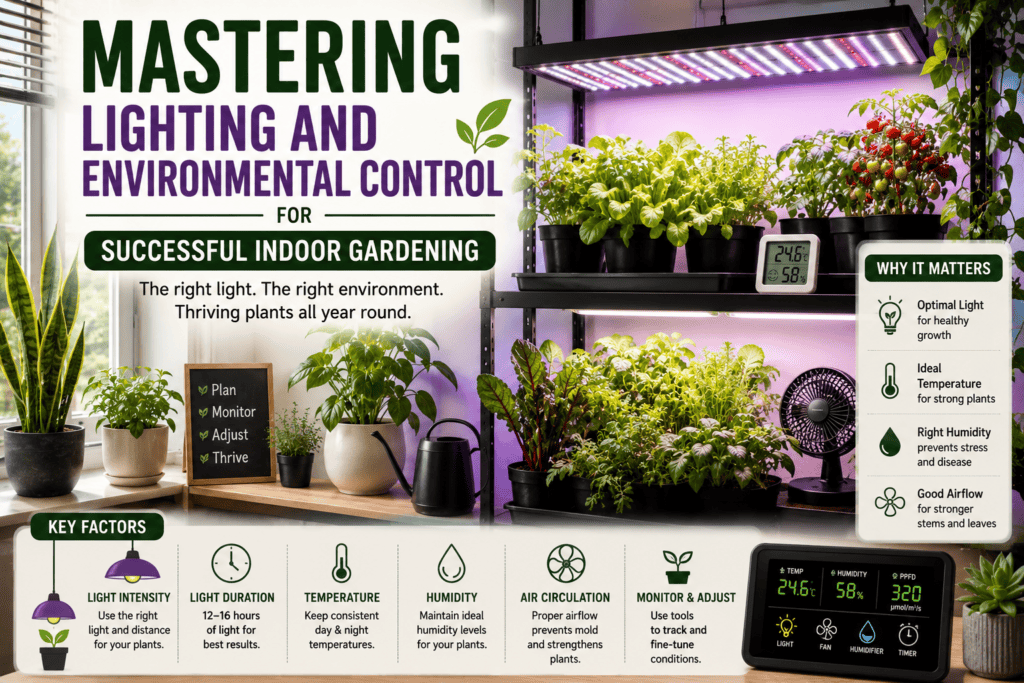
Mastering Lighting and Environmental Control for Successful Indoor Gardening
Selecting the Right Lighting Technology for Small Spaces
Successful indoor gardening in confined areas relies heavily on choosing the right artificial light source. Traditional options like High-Intensity Discharge (HID) lights emit intense light but generate extreme heat. In a small closet or tight shelving unit, HID lamps quickly bake plants and dry out growing media.
Fluorescent lights, particularly T5 tubes, run much cooler and have long been favored for seed starting and leafy greens. However, they lack the spectral intensity required for fruiting or flowering plants, and their bulky fixtures take up valuable vertical space.
Light Emitting Diodes (LEDs) have become the industry standard for compact indoor gardening. LEDs convert electricity to light with exceptional efficiency, producing minimal ambient heat. This allows you to position the light source much closer to the plant canopy without risking leaf burn. Furthermore, LEDs last tens of thousands of hours longer than fluorescent bulbs and use a fraction of the electricity, keeping utility bills manageable.
When designing a small-scale indoor garden, three main LED form factors dominate:
- T5 LED Strips: These slim, lightweight bars mimic traditional fluorescent tubes but offer modern efficiency. They are ideal for tight, multi-tier wire shelving units where vertical clearance is limited to 12 to 18 inches. They work best for microgreens, herbs, and leafy greens.
- COB (Chip-on-Board) LEDs: These pack multiple LED diodes onto a single small chip, creating a highly concentrated, intense point source of light. COBs penetrate dense canopies well, making them excellent for taller plants grown in small grow tents. However, they generate localized heat at the chip, requiring robust heat sinks.
- Quantum Boards: These flat, wide circuit boards feature hundreds of small mid-power diodes spread across a large surface area. Quantum boards distribute light evenly across a flat footprint and dissipate heat passively through the aluminum board itself. This thin profile makes them perfect for maximizing vertical growing space on shelves or inside small cabinets.
—
Understanding Light Metrics: Lumens vs. PAR
Human eyes and plants perceive light differently. Lumens measure brightness based on human visual sensitivity, which peaks in the yellow-green spectrum. Plants, however, ignore most green light and primarily absorb blue and red wavelengths to drive photosynthesis.
To measure light from a plant’s perspective, you must use PAR, or Photosynthetically Active Radiation. PAR designates the spectral waveband of solar radiation from 400 to 700 nanometers.
Human Eye
Measures perceived brightness, especially in the yellow-green portion of the spectrum.
Plant Leaf
Measures light wavelengths plants can use for photosynthesis, including blue and red light.
To determine the actual intensity of PAR landing on your plants, measure the Photosynthetic Photon Flux Density (PPFD). PPFD represents the number of photosynthetically active photons hitting a one-square-meter area per second, expressed as micromoles per square meter per second ($\mu\text{mol/m}^2/\text{s}$).
Different indoor gardening crops require distinct PPFD levels to thrive:
- Low-light plants (herbs, leafy greens, seedlings): Require a PPFD of $100$ to $250\ \mu\text{mol/m}^2/\text{s}$.
- Medium-light plants (strawberries, bush beans): Require a PPFD of $300$ to $450\ \mu\text{mol/m}^2/\text{s}$.
- High-light plants (dwarf tomatoes, peppers): Require a PPFD of $500$ to $900\ \mu\text{mol/m}^2/\text{s}$.
To calculate the total light your indoor garden receives over a full day, use the Daily Light Integral (DLI). DLI measures the cumulative moles of light delivered to a square meter over a 24-hour period ($\text{mol/m}^2/\text{day}$).
You can balance light intensity and duration to achieve the target DLI. For example, if you grow lettuce, which needs a DLI of around $14$ to $17\ \text{mol/m}^2/\text{day}$, you can use a lower PPFD light run for 18 hours, or a higher PPFD light run for 12 hours.
To calculate DLI, use this formula:
$$\text{DLI} = \text{PPFD} \times \text{Daily Light Hours} \times 0.0036$$
If your LED grow light delivers a PPFD of $300\ \mu\text{mol/m}^2/\text{s}$ at the canopy level and runs for 16 hours, the calculation is:
$$300 \times 16 \times 0.0036 = 17.28\ \text{mol/m}^2/\text{day}$$
This matches the needs of leafy greens perfectly without wasting electricity.
—
Environmental Management in Enclosed Spaces
An enclosed indoor gardening setup can quickly trap humidity and heat, creating a stagnant microclimate. Without active intervention, transpiration from plant leaves raises relative humidity, which slows down plant growth and invites fungal pathogens like powdery mildew.
Airflow Systems
Passive airflow relies on open vents or mesh screens to let air circulate naturally. While sufficient for a single open shelf, passive airflow fails in enclosed cabinets or grow tents.
Active airflow utilizes mechanical fans to exchange air. You need two types of fans:
- Oscillating Fans: Small, low-wattage clip-on fans keep air moving gently within the growing area. This constant breeze prevents stagnant air pockets around leaves, strengthens plant stems, and disrupts pest life cycles.
- Inline Exhaust Fans: These pull warm, humid air out of the grow space, drawing fresh, carbon-dioxide-rich air in through passive intake vents. For small spaces, a 4-inch inline fan is usually sufficient to refresh the entire volume of air once every minute.
Humidity Control
For most indoor crops, target a relative humidity (RH) between 40% and 60%. If humidity drops too low, plants close their stomata to conserve water, halting photosynthesis. If humidity climbs too high, plants cannot transpire, which stops nutrient uptake through the roots.
“` Low Humidity (<40%) —> Stomata close, growth stalls Target Range (40-60%) —> Optimal transpiration and nutrient uptake High Humidity (>60%) —> Transpiration stops, mold risk rises “`
In micro-gardens, you can raise humidity by placing shallow trays filled with pebbles and water beneath the plants. The water evaporates slowly, raising local humidity without wetting the foliage.
To lower humidity in tight spaces, run a compact thermo-electric (Peltier) dehumidifier inside the enclosure, or increase the speed of your exhaust fan to bring in drier ambient room air.
Heat Mitigation
Even highly efficient LEDs generate some heat, primarily from the driver (the power supply) rather than the diodes. If your grow space runs too hot, mount the LED driver outside the growing enclosure using extension cables.
Additionally, select fixtures with thick aluminum heat sinks to draw heat away from the diodes passively.
You can also run your light cycles at night when ambient room temperatures are naturally cooler. This reduces the load on your ventilation system and keeps daytime temperatures stable.
—
Automation and Precision Control
Managing an indoor garden manually requires constant attention. Automation stabilizes the growing environment, ensuring your plants receive consistent care even when you are away.
“` [Sensors: Temp/Humidity] —> [Smart Controller] —> [Triggers: Fan/Humidifier/Lights] “`
Smart Timers and Photoperiods
Plants rely on consistent day and night lengths to regulate their growth cycles. Mechanical dial timers are inexpensive and reliable for setting basic light schedules, such as 16 hours on and 8 hours off.
For more flexibility, smart Wi-Fi plugs allow you to program schedules down to the minute via a smartphone app. They also let you monitor real-time energy consumption and adjust schedules remotely.
Sensor Integration
Modern digital hygrometers and thermometers equipped with Bluetooth or Wi-Fi record environmental data continuously. Instead of checking a manual thermometer once a day, these sensors log data points every few minutes and plot them on a graph. This allows you to identify critical temperature spikes or humidity drops that occur when you are asleep or at work.
Automated Trigger Systems
To achieve true precision, connect your environmental equipment to a smart controller or sensor-integrated power strip. These devices use conditional “If/Then” logic to manage your grow space automatically:
- High Temperature Trigger: If the temperature sensor reads above 82°F, the controller powers on the inline exhaust fan to pull in cooler air.
- Low Humidity Trigger: If the relative humidity drops below 45%, the controller activates a small ultrasonic humidifier.
- High Humidity Trigger: If the humidity climbs above 65%, the controller switches on a dehumidifier or increases exhaust fan speed.
Automating these micro-adjustments prevents the dramatic environmental swings that stress plants, leading to faster growth rates and healthier yields in small spaces.
—
Frequently Asked Questions
How many hours of light do indoor plants need daily?
Most indoor vegetables and herbs need between 12 and 18 hours of light per day. Leafy greens and herbs grow well with 14 to 16 hours of light. Fruiting plants like tomatoes and peppers prefer 16 to 18 hours during their vegetative growth phase, but can be scaled back to 12 hours if you are growing photoperiod-sensitive varieties that require equal day and night lengths to trigger flowering.
What is the difference between lumens and PAR for plant growth?
Lumens measure how bright a light source appears to the human eye, focusing primarily on green and yellow wavelengths. PAR (Photosynthetically Active Radiation) measures the specific band of light between 400 and 700 nanometers that plants actually use for photosynthesis. When buying grow lights, ignore lumen ratings and look for PAR or PPFD values.
How do I maintain optimal humidity in a small indoor garden?
To raise humidity, place water-filled pebble trays beneath your pots or run a small ultrasonic humidifier nearby. To lower humidity, increase the speed of your exhaust fan to exchange humid air with drier room air, or place a compact Peltier-style dehumidifier inside your growing enclosure. Aim to keep the relative humidity between 40% and 60%.
Can indoor plants grow without natural sunlight?
Yes, indoor plants can grow and complete their entire life cycle without any natural sunlight. Modern full-spectrum LED grow lights emit a balanced range of blue, red, and far-red light that closely mimics the natural spectrum of the sun, providing all the energy plants need for photosynthesis.
What are the signs of light stress in indoor plants?
Light stress occurs when grow lights are too close or too intense. Common signs include leaf bleaching (where leaves turn white or pale yellow while the veins stay green), downward-curling leaf tips, dry or crispy brown leaf edges, and stunted, overly dense growth. If you notice these symptoms, raise your lights or dim their intensity.