
I Redesigned My Tiny Balcony Using Japanese Zen Principles — It Changed How I Start Every Morning
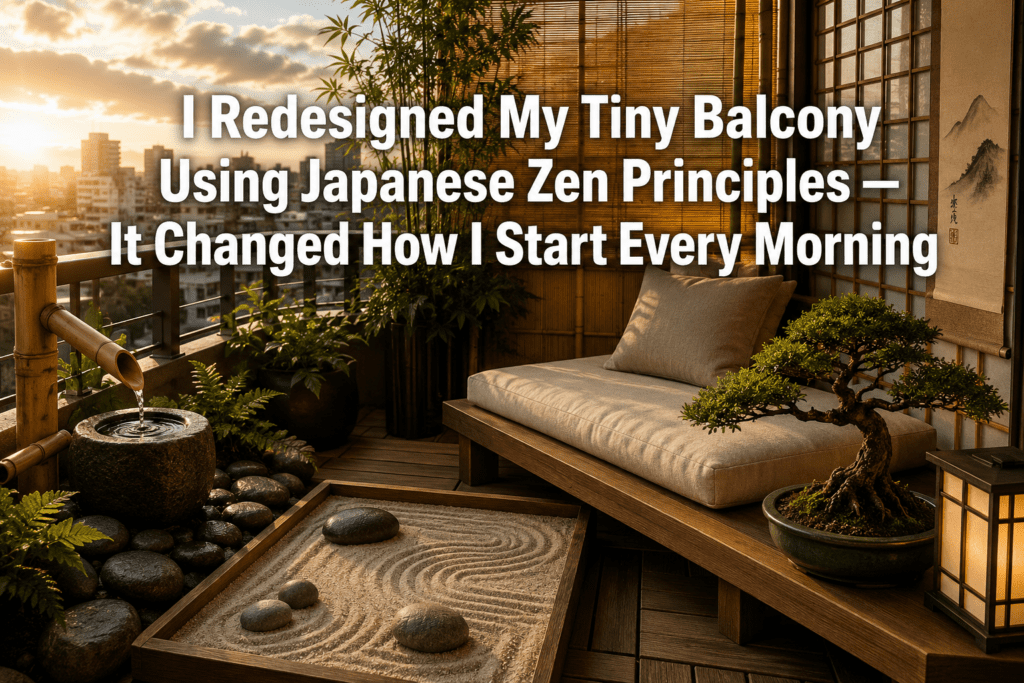
Quick Answer: Redesigning a small balcony using Japanese zen principles — including negative space, natural materials, and intentional plant placement — can transform even a 30-square-foot urban outdoor area into a calming morning ritual space. The process typically costs between $80 and $300, takes one weekend to set up, and requires minimal ongoing maintenance. The psychological payoff, particularly reduced morning stress, is real and immediate for most people who commit to the design philosophy.
Key Takeaways
- Japanese zen design relies on five core principles: ma (negative space), wabi-sabi (imperfect beauty), simplicity, natural materials, and mindful plant selection.
- A functional zen balcony costs $80–$300 depending on materials and plant choices.
- Setup takes one to two days for most small balconies under 50 square feet.
- The best plants for zen balconies include Japanese maples, moss balls (kokedama), bamboo grass, and low-maintenance succulents.
- Zen design works especially well in urban apartments where outdoor space is limited and stress is high.
- The biggest mistakes are overcrowding the space, using synthetic materials, and ignoring wind conditions.
- Zen and modern minimalism overlap but are not the same — zen prioritizes nature and imperfection; minimalism prioritizes clean lines and function.
- Maintenance is low: 10–15 minutes per week is enough for most zen balcony setups.
What Are the Key Principles of Zen Garden Design?
Japanese zen garden design is built on five foundational ideas that guide every decision, from where you place a stone to how much empty floor space you leave.
The five core principles are:
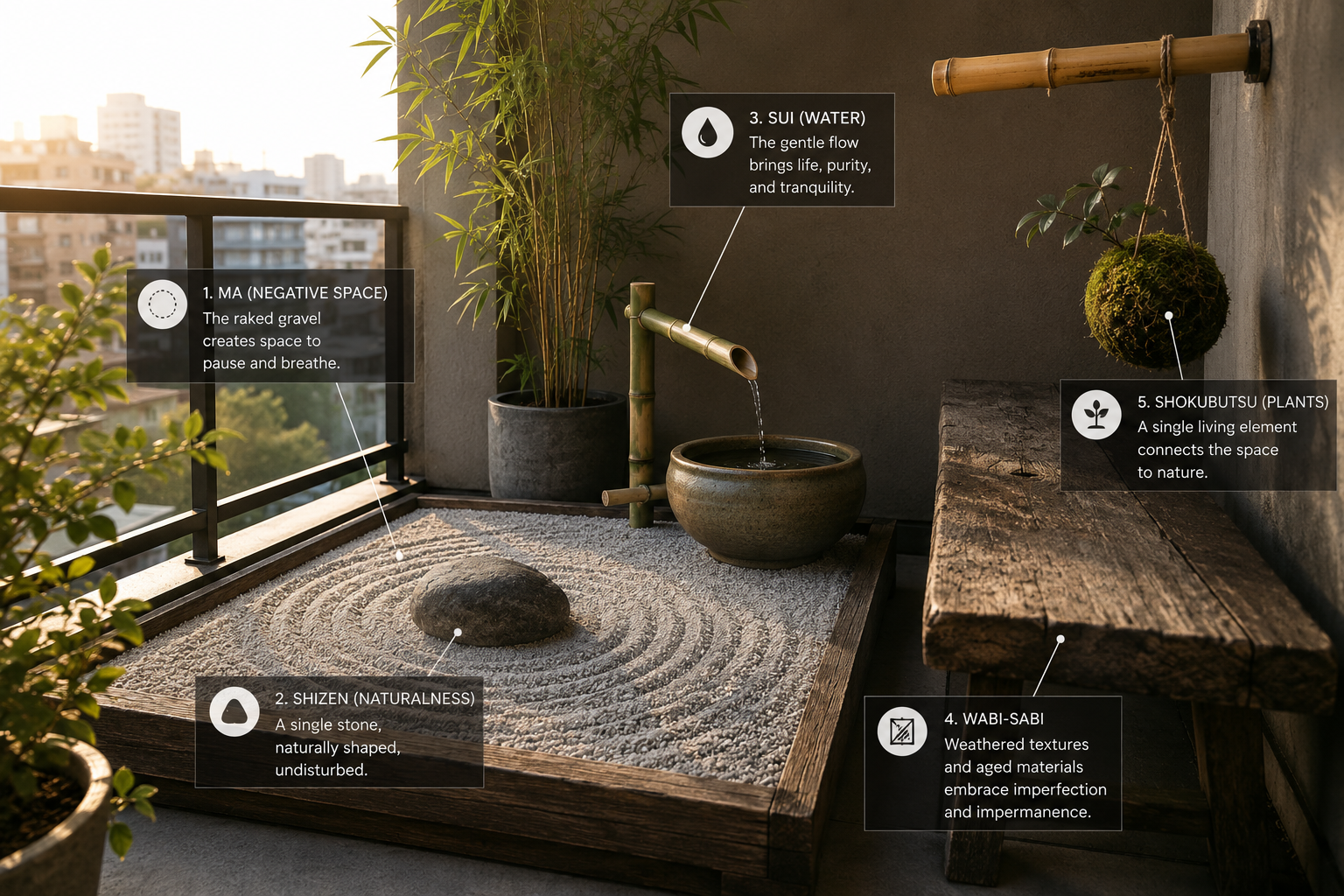
- Ma (間) — Negative space: Empty space is not wasted space. It’s intentional. Leave at least 40% of your balcony floor visually clear.
- Wabi-sabi (侘寂) — Imperfect beauty: Aged wood, cracked ceramic, and moss-covered stone are features, not flaws. Don’t chase perfection.
- Kanso — Simplicity: Remove anything that doesn’t serve a purpose or bring calm. One beautiful plant beats five mediocre ones.
- Shizen — Natural materials: Stone, wood, bamboo, ceramic, and linen. Avoid plastic and synthetic finishes wherever possible.
- Yugen — Subtle mystery: Create a sense of depth or suggestion — a bamboo screen that partially hides a corner, or a plant that draws the eye without demanding attention.
Common mistake: Most people apply minimalism but skip wabi-sabi. They want everything to look new and perfect, which actually works against the zen effect. A slightly weathered wooden stool is more authentic than a pristine one.
How Much Does It Cost to Create a Zen Balcony?
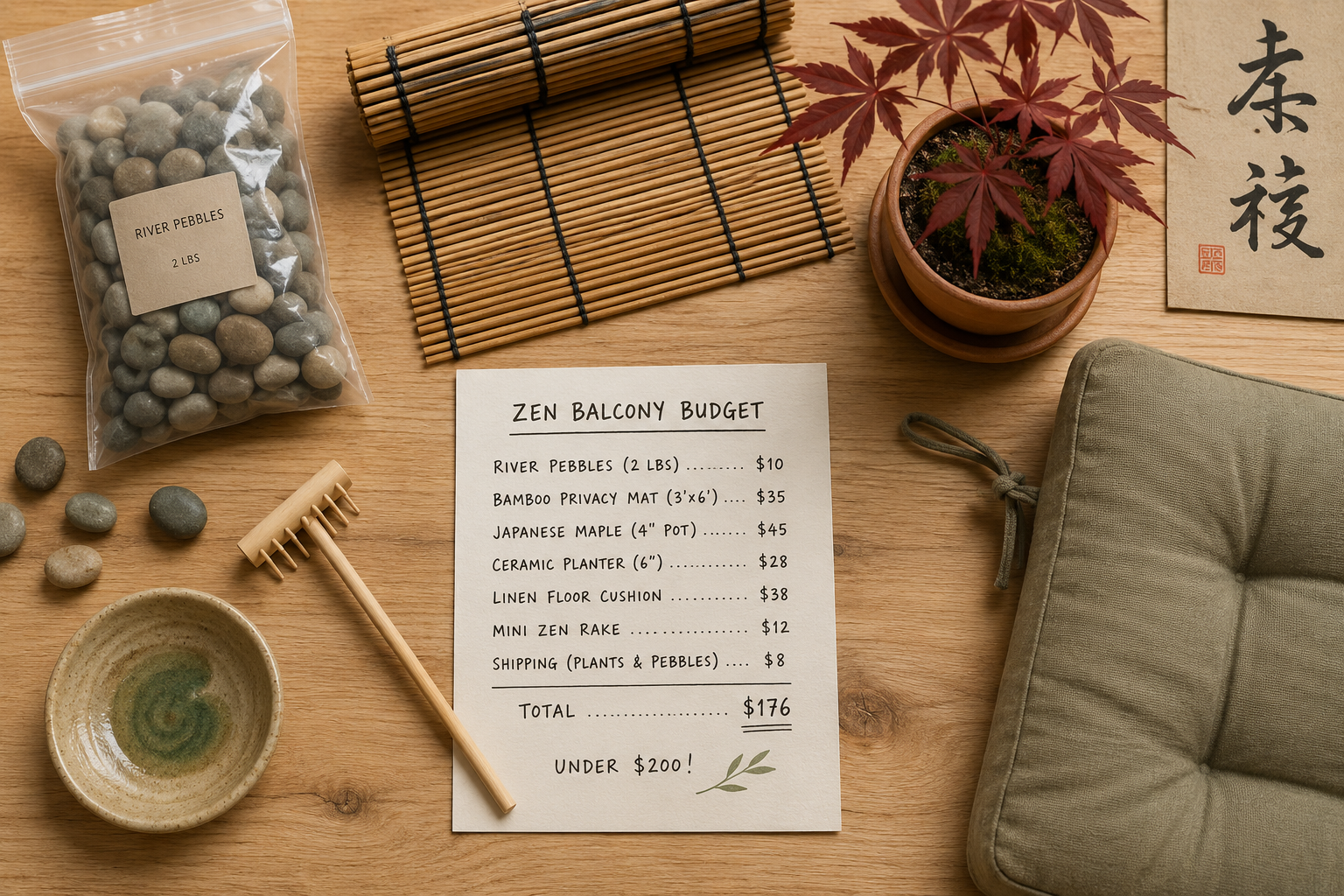
A basic zen balcony makeover costs between $80 and $300 for most small urban spaces. You don’t need expensive furniture or rare plants.
| Budget Tier | What You Get | Estimated Cost |
|---|---|---|
| Starter ($80–$120) | Bamboo mat, river stones, 1–2 plants, small rake tray | ~$100 |
| Mid-range ($150–$220) | Wooden platform, ceramic pots, kokedama, bamboo screen | ~$185 |
| Full setup ($250–$300) | Water feature, bonsai or Japanese maple, quality cushions, lighting | ~$280 |
Where to save money: River stones and gravel are cheap at garden centers. Bamboo mats cost $15–$25 at most home stores. Kokedama (moss ball plants) can be made at home for under $10 with potting soil, peat, and sheet moss.
Where not to cut corners: The floor covering matters most. A quality bamboo or cedar mat sets the visual tone for the entire space. Spending $30–$50 here pays off more than any single plant purchase.
For more ideas on keeping costs manageable, see this guide on budget balcony gardening ideas.
What Plants Work Best in a Small Zen Balcony Space?
The best plants for a zen balcony are those that look intentional, require minimal fuss, and connect visually to Japanese garden aesthetics.
Top choices for small zen balconies:
- Japanese maple (Acer palmatum): Stunning in a ceramic pot, changes with the seasons, manageable in containers.
- Kokedama (moss ball plants): Any plant wrapped in moss and twine works — ferns, pothos, or peace lilies are popular choices.
- Lucky bamboo or clumping bamboo grass: Adds vertical movement without taking floor space.
- Succulents and sedums: Low maintenance, sculptural, and pair well with stone arrangements.
- Mondo grass (Ophiopogon japonicus): A classic Japanese garden ground cover that stays compact in pots.
- Bonsai: Requires more attention but is the most iconic zen plant if you’re willing to learn basic care.
Choose plants based on your light conditions. If your balcony gets fewer than 4 hours of direct sun, skip Japanese maple and bonsai. Opt for ferns, moss, and shade-tolerant grasses instead. You can explore the best plants for balcony gardens for a broader selection matched to different conditions.
Wind tip: High-rise balconies need wind-resistant choices. Bamboo grass and succulents handle wind far better than large-leafed plants. See this wind-resistant balcony plants guide for specifics.
Can Zen Design Help Reduce Stress in a Small Apartment?
Yes, and there’s solid reasoning behind it. Research published in the journal Frontiers in Psychology (2019) found that exposure to natural elements and green spaces — even small ones — measurably reduces cortisol levels and self-reported stress. A zen balcony applies this directly: natural materials, plants, water sounds, and uncluttered space all activate the parasympathetic nervous system.
When I redesigned my tiny balcony using Japanese zen principles, the shift wasn’t dramatic on day one. But within two weeks, I noticed I was spending 10–15 minutes outside each morning before checking my phone. That single habit change reduced my baseline morning anxiety noticeably.
Why it works in small apartments specifically:
- The contrast effect: stepping from a cluttered indoor space into a calm, intentional outdoor area amplifies the psychological reset.
- Ritual anchoring: a dedicated, beautiful space makes it easier to build a consistent morning routine.
- Sensory shift: natural textures, plant smells, and ambient sound (even city noise filtered through bamboo) engage the senses differently than screens do.
“The space doesn’t need to be large to be restorative. It needs to be intentional.”
Is Zen Balcony Design Good for People With Limited Outdoor Space?
Zen design is arguably better for small spaces than for large ones. The philosophy was developed in Japanese temple gardens where space was always constrained and every element had to earn its place.
A balcony as small as 20–30 square feet is enough. The design principles actually discourage filling space, so a smaller footprint forces the right decisions.
Who this works best for:
- Urban apartment dwellers with a single small balcony
- Renters who can’t make permanent changes (most zen elements are portable)
- People who feel overwhelmed by complex gardening systems
Who might struggle:
- Anyone who wants abundant, lush planting — zen design deliberately avoids this
- People in very high-wind, high-rise locations where delicate elements won’t survive
For renters specifically, check out this balcony gardening guide for renters which covers what you can and can’t modify in most lease agreements.
What Materials Do I Need to Create a Zen Balcony?
You need seven core material categories to build a functional zen balcony. Most are available at garden centers, home stores, or online.
Essential materials:
- Floor covering: Bamboo mat, cedar decking tiles, or smooth river stone path
- Gravel or sand tray: A shallow wooden or ceramic tray filled with fine gravel for the raked “dry garden” element
- Stones: 3–7 smooth river stones in varied sizes (odd numbers look more natural)
- Containers: Ceramic, terracotta, or aged wood planters — avoid plastic
- Plants: 2–4 species maximum (see plant section above)
- Screen or divider: Bamboo roll screen for privacy and visual framing
- Seating: One low platform seat or floor cushion — nothing more
Optional additions: A small bamboo water feature ($25–$60), a single lantern-style light, or a hanging kokedama.
For container selection guidance, the best planters for small apartments guide covers sizes, materials, and drainage requirements in detail.
How Long Does It Take to Set Up a Zen Balcony?
Most people complete a zen balcony setup in one full day or two half-days. The process is straightforward once you have your materials.
Rough timeline:
- Planning and sourcing materials: 2–4 hours (can be done online)
- Clearing and cleaning the balcony: 30–60 minutes
- Laying floor covering: 30 minutes
- Arranging stones, gravel tray, and screens: 1–2 hours
- Potting and placing plants: 1 hour
- Final adjustments and styling: 30 minutes
Total: 5–8 hours across one weekend
The slowest part is usually the plant sourcing, especially if you want a Japanese maple or a specific bonsai variety. Order plants at least a week ahead if buying online.
Mistakes to Avoid When Creating a Zen Balcony
The most common mistake is treating a zen balcony like a regular garden and adding too many elements. Overcrowding destroys the ma principle and makes the space feel chaotic rather than calm.
Other mistakes to avoid:
- Using synthetic materials: Plastic pots, artificial grass, and metal furniture break the natural material rule and look out of place.
- Ignoring wind: Tall, top-heavy plants and lightweight gravel trays will be problems on exposed balconies. Test with a small stone before committing to a full gravel setup.
- Skipping drainage: Ceramic pots without drainage holes will kill plants. Always check before buying. The guide on how indoor plants drain in pots without holes explains workarounds.
- Buying too many plants at once: Start with two plants. Add a third after a month if the space feels right.
- Neglecting the floor: Most people focus on plants and ignore the floor. The floor covering sets the entire visual tone.
Also see balcony gardening mistakes to avoid in 2026 for a broader list of common errors.
How Do I Maintain a Zen Balcony Garden With Minimal Effort?
A properly designed zen balcony needs only 10–15 minutes of maintenance per week. That’s intentional — the design philosophy favors low-intervention plants and materials.
Weekly maintenance checklist:
- Rake the gravel tray (2–3 minutes, meditative in itself)
- Water plants based on their individual needs — most zen plants prefer infrequent, deep watering
- Remove any fallen leaves or debris
- Wipe down stone surfaces if dusty
Monthly tasks:
- Check drainage holes for blockage
- Rotate pots so all sides get light exposure
- Trim any overgrowth on bamboo or grasses
Seasonal tasks:
- Repot plants that have outgrown their containers (usually once per year)
- Refresh gravel if it has discolored or compacted
For a complete maintenance schedule, the balcony garden maintenance tips guide covers seasonal care in detail.
What Are Alternatives to Traditional Zen Garden Elements?
Not every traditional zen element is practical for a balcony. Here are direct substitutes that preserve the aesthetic without the limitations.
| Traditional Element | Balcony Alternative |
|---|---|
| Raked sand garden | Small wooden tray with fine gravel or pea gravel |
| Koi pond | Ceramic bowl with water, pebbles, and a floating plant |
| Stone lantern | Solar-powered ceramic lantern |
| Moss ground cover | Kokedama hanging plants or moss in a shallow dish |
| Bamboo grove | Single clumping bamboo grass in a tall ceramic pot |
| Shoji screen | Bamboo roll screen or reed fence panel |
These alternatives keep the spirit of zen design intact while working within the physical and structural limits of most apartment balconies.
Difference Between Japanese Zen and Modern Minimalist Design
Japanese zen and modern minimalism look similar on the surface but come from different philosophies and produce different results.
Japanese zen design:
- Rooted in Buddhist philosophy and nature observation
- Embraces imperfection, aging, and organic forms (wabi-sabi)
- Uses exclusively natural materials
- Incorporates living elements — plants, water, moss
- Asymmetry is intentional and preferred
Modern minimalism:
- Rooted in 20th-century design movements (Bauhaus, Scandinavian)
- Prefers clean lines, symmetry, and flawless surfaces
- Allows synthetic and industrial materials
- Often avoids living elements in favor of clean geometry
- Function drives every decision
The practical difference: A minimalist balcony might have two sleek concrete planters and a white metal chair. A zen balcony has a weathered wooden platform, an aged ceramic pot with a Japanese maple, and three river stones arranged asymmetrically. Both are uncluttered, but only one feels alive.
For inspiration on how these styles can blend, see modern balcony garden designs for 2026 trend examples.
Can Zen Design Work in Urban Environments With Small Balconies?
Yes — urban environments are where zen design delivers the most value. The contrast between a noisy, busy city and a calm, natural balcony space amplifies the restorative effect.
Adaptations for urban zen balconies:
- Use a bamboo screen to visually block the urban view and create a sense of enclosure
- Add a small water feature to mask street noise with natural sound
- Choose plants that tolerate pollution and variable light (bamboo grass, succulents, mondo grass)
- Keep the gravel tray covered when not in use if your city has heavy air pollution
The key insight from my experience redesigning my tiny balcony using Japanese zen principles is that the city doesn’t disappear — but it stops being the dominant sensory experience. The balcony becomes a frame that holds your attention differently.
FAQ
Q: Do I need any gardening experience to create a zen balcony?
No. Zen balcony design favors low-maintenance plants and simple arrangements. If you can water a plant once a week and rake gravel, you have all the skills you need.
Q: Can I create a zen balcony if I’m renting?
Yes. All zen elements are portable — bamboo mats, ceramic pots, gravel trays, and roll screens require no permanent installation. Check your lease for weight limits on balconies.
Q: How many plants should a zen balcony have?
Two to four plants is the right range for most small balconies. More than four tends to create visual clutter that undermines the zen effect.
Q: Does a zen balcony need direct sunlight?
Not necessarily. Many zen-appropriate plants (ferns, moss, mondo grass, peace lily kokedama) thrive in partial shade. Assess your light conditions before choosing plants.
Q: What’s the single most important element in a zen balcony?
Negative space. Leaving at least 40% of the floor area clear does more for the zen atmosphere than any plant or decoration you can add.
Q: Can children or pets use a zen balcony safely?
Yes, with minor adjustments. Secure the gravel tray so it can’t be knocked over, and verify that your plant choices are non-toxic. Japanese maple, bamboo grass, and mondo grass are generally pet-safe.
Q: How is a zen balcony different from just a tidy balcony?
A tidy balcony removes clutter. A zen balcony uses intentional placement, natural materials, and living elements to create a space that actively promotes calm — not just the absence of mess.
Q: Will a zen balcony add value to my apartment?
Not in a financial sense for renters. But it adds significant quality-of-life value, and the portable elements move with you when you leave.
Conclusion: Your Next Steps
When I redesigned my tiny balcony using Japanese zen principles, I expected a prettier outdoor space. What I got was a reliable morning ritual that changed how I approach the first hour of every day. The space is 28 square feet. The total cost was under $200. The setup took one Saturday.
Here’s how to start this weekend:
- Clear everything off your balcony completely — start from zero.
- Identify your light conditions (full sun, partial shade, or shade).
- Choose one floor covering: bamboo mat or cedar deck tiles.
- Buy two plants suited to your light conditions and two ceramic pots.
- Add a small gravel tray and five river stones.
- Leave at least 40% of the floor empty.
- Sit in the space for 10 minutes the next morning before checking your phone.
That last step is the one that makes it work. The space only changes your mornings if you actually use it.
For broader inspiration on transforming small outdoor areas, explore balcony garden decor ideas for 2026 and small balcony garden ideas to see what’s possible in compact spaces.
References
- Kaplan, R., & Kaplan, S. (1989). The Experience of Nature: A Psychological Perspective. Cambridge University Press.
- Bratman, G. N., Hamilton, J. P., & Daily, G. C. (2012). The impacts of nature experience on human cognitive function and mental health. Annals of the New York Academy of Sciences, 1249(1), 118–136. https://doi.org/10.1111/j.1749-6632.2011.06400.x
- Joye, Y., & van den Berg, A. (2011). Is love for green in our genes? A critical analysis of evolutionary assumptions in restorative environments research. Urban Forestry & Urban Greening, 10(4), 261–268.
- White, M. P., et al. (2019). Spending at least 120 minutes a week in nature is associated with good health and wellbeing. Scientific Reports, 9, 7730. https://doi.org/10.1038/s41598-019-44097-3
- Kuitert, W. (2002). Themes in the History of Japanese Garden Art. University of Hawaii Press.