What is a succession planting schedule for beginners (what and when)?
Ever wished your garden kept producing fresh vegetables all season long instead of a massive, overwhelming harvest all at once? The secret to a continuous yield, especially for those new to gardening, is mastering a succession planting schedule. This strategy allows you to enjoy a steady supply of fresh produce by staggering your plantings throughout the growing season, preventing gluts and ensuring there’s always something ready to pick.
Key Takeaways
- Succession planting involves staggering plantings to ensure a continuous harvest, avoiding overwhelming gluts of produce.
- Beginners should start with fast-maturing crops like lettuce, radishes, and green beans.
- Common methods include planting small batches every 2-3 weeks, using early/mid/late varieties, or the “half and half” approach for limited space.
- Timing is crucial, based on crop maturity and local frost dates.
- Documentation of planting dates is essential for tracking and planning future seasons.
- Start small to avoid common beginner mistakes of overplanting and wasted harvest.
- Cool-season crops offer flexibility, allowing plantings into late summer for fall harvests.
- Water management is vital for establishing new succession plantings.
Quick Answer
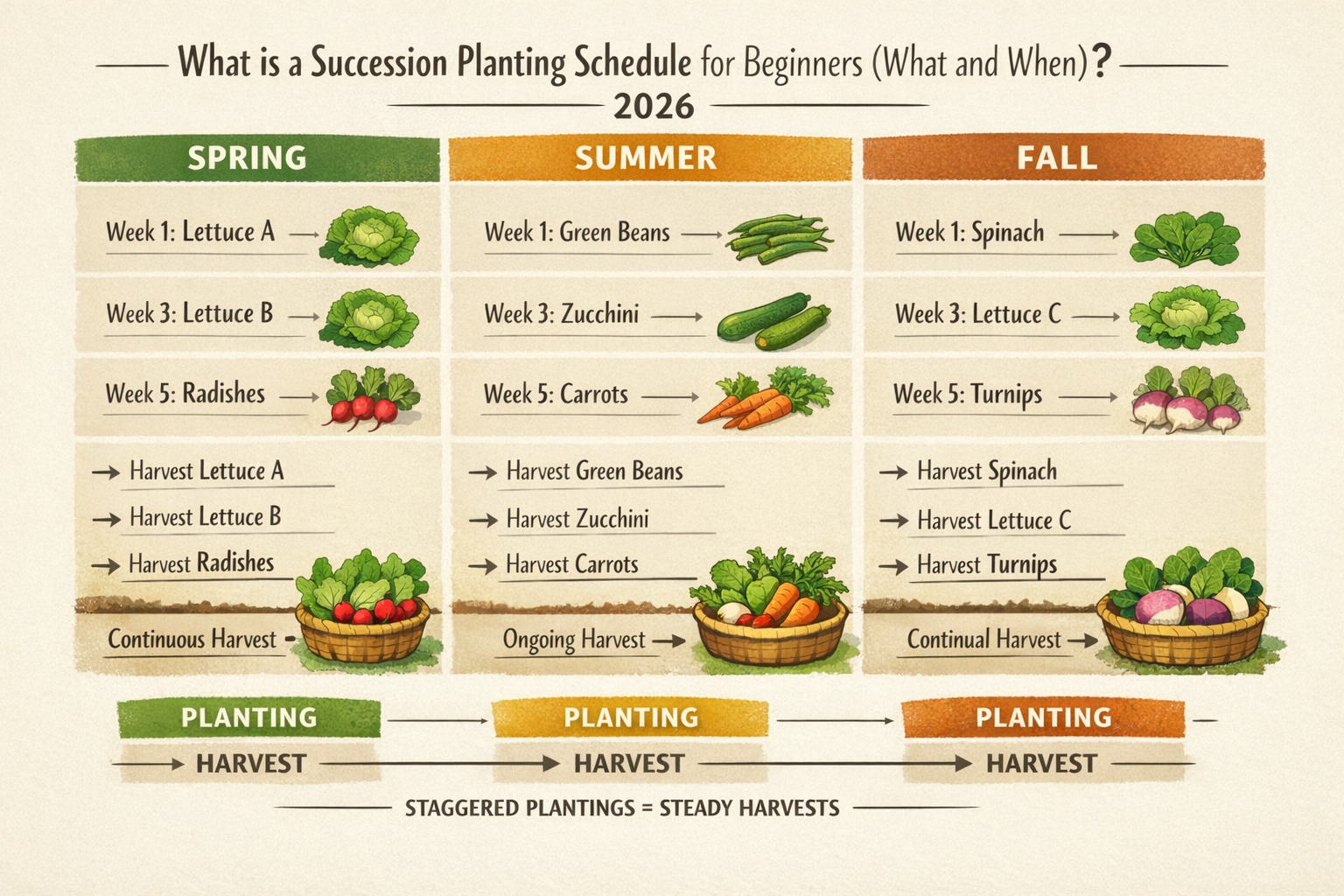
A succession planting schedule for beginners is a method of planting small amounts of crops at staggered intervals throughout the growing season to ensure a continuous, manageable harvest rather than a single large yield. This strategy answers “what to plant” by focusing on fast-maturing vegetables and “when to plant” by timing successive plantings every 2-3 weeks, considering your local frost dates.
What is a Succession Planting Schedule for Beginners (What and When)?
A succession planting schedule is a gardening technique where you sow seeds or transplant seedlings at regular intervals, rather than planting an entire crop all at once, to extend your harvest season and ensure a steady supply of fresh produce [2, 5]. For beginners, this means consistently having vegetables like crisp lettuce or crunchy radishes ready for the table, instead of a bumper crop that ripens simultaneously and then quickly fades. This approach is particularly valuable for small space gardening, where maximizing yield from limited areas is key [4, 7].
Understanding the Concept of Continuous Harvest
The core idea behind succession planting is to prevent the feast-or-famine cycle that often plagues new gardeners. Imagine planting an entire packet of lettuce seeds in April. You’d likely have an abundance of lettuce ready in late May, but by mid-June, all the plants might bolt (go to seed), leaving you with no fresh lettuce for the rest of summer. By planting a small batch every two to three weeks, you ensure a fresh supply is always maturing as previous plantings are harvested [1]. This practice enhances productivity and provides a more manageable output, which is especially beneficial if you’re exploring small space vegetable gardening.
Why is it Important for Beginners?
For beginners, succession planting helps build confidence and reduces waste. Overplanting is a common mistake that leads to excess produce, which can rot before it’s consumed or processed [1]. By starting small and staggering plantings, you learn to gauge your family’s consumption rate and adjust future planting quantities accordingly. It also keeps the gardening experience engaging throughout the season, as there’s always something new to plant, tend, and harvest. This aligns well with the principles of efficient container gardening and maximizing limited space.
Which Crops are Best for a Beginner’s Succession Planting Schedule?
For beginners looking to implement a succession planting schedule, fast-maturing crops are the ideal starting point because they offer quick results and allow for more frequent successions within a single growing season. These crops typically mature in less than 60 days, enabling multiple planting cycles.
Top Choices for Fast-Maturing Vegetables
When selecting crops, prioritize those with short “days to maturity.” This allows for a quicker turnover and more opportunities to replant. Here are some excellent options for beginners:
- Radishes: These zesty root vegetables are champions of speed, maturing in just 25-30 days [1]. You can practically plant a new batch every two weeks.
- Lettuce and Salad Greens: With a maturity window of 45-60 days, lettuce varieties (like loose-leaf or butterhead) and other salad greens are perfect for consistent harvests. They also tolerate some shade, making them versatile for different garden spots [1].
- Bush Green Beans: Maturing in 50-60 days, bush beans offer a good yield without needing trellises, making them ideal for small spaces. Snap beans are a fantastic choice for consistent picking [1].
- Carrots: While slightly longer at 60-75 days, short-rooted varieties can be planted every few weeks for a steady supply of sweet roots [1].
- Beets: Both the roots and greens are edible, with maturity typically around 50-60 days [1].
- Summer Squash: Zucchini and other summer squash varieties mature quickly (45-55 days) and are highly productive. Plant just one or two plants per succession to avoid overabundance [1].
- Herbs: Cilantro (50-55 days) and dill (40-60 days) are excellent for succession planting, as they tend to bolt quickly in warm weather. Staggering ensures you always have fresh leaves [1].
Tip for Beginners: Start with just 2-3 feet of row for each crop, or 1-2 containers. This amount is manageable and prevents feeling overwhelmed by a large initial planting [1].
Why Avoid Long-Season Crops Initially?
While rewarding, crops like tomatoes, peppers, and winter squash have longer maturity periods (often 70+ days) and typically produce for an extended time from a single planting. For beginners focusing on succession planting, these are less suitable as primary succession crops because they don’t benefit as much from staggered planting intervals for continuous, fresh-from-the-ground harvests. They are better suited for a single, larger planting at the beginning of the warm season. If you’re looking for easy plants to grow in small spaces, these fast-maturing vegetables are your best bet.
When Should You Start and Continue a Succession Planting Schedule?
Timing is the most critical element of a succession planting schedule, dictating both when to start your first crops and how frequently to replant throughout the season. Proper timing ensures you maximize your growing window and avoid planting too early or too late.
Starting Your First Plantings
The beginning of your succession planting journey is tied directly to your local last and first frost dates. These dates define your region’s growing season.
- Cool-Season Crops: For vegetables like lettuce, radishes, spinach, and brassicas, you can often begin planting outdoors 2-3 weeks before your last expected spring frost [1]. These crops tolerate cooler temperatures and even light frosts. For example, in early 2026, the Farmers’ Almanac recommended good planting days for cool-season crops like lettuce, spinach, onions, leeks, and brassicas for indoor starts between February 1-3 [9].
- Warm-Season Crops: Wait until after your last frost date for heat-loving plants such as green beans, cucumbers, and summer squash. The soil temperature should ideally reach 60°F (15°C) to ensure good germination and growth [1]. Planting too early in cold soil can lead to poor germination and stunted plants.
Decision Rule: If you live in a region with a short growing season, start cool-season crops indoors 4-6 weeks before your last frost to get a head start. For more guidance, see our Ultimate Guide to Small Space Gardening for Beginners 2026.
Establishing Planting Intervals
Once you’ve made your initial planting, the secret to continuous harvest lies in consistent replanting.
- Standard Interval: For most succession crops, a planting interval of every 2-3 weeks is recommended [1]. This ensures that as one batch matures and is harvested, the next batch is well on its way.
- Faster Crops: Exceptionally fast crops like radishes and some loose-leaf lettuces can be planted as frequently as every two weeks [1].
- Slower Crops: For crops with slightly longer maturity rates, you might stretch the interval to 3-4 weeks.
Example Schedule:
If you plant your first lettuce on April 15, plan your next small planting for May 1, then May 15, and so on.
Determining Late-Season Planting Deadlines
Don’t just stop planting in summer! Succession planting can extend well into fall. To figure out your last possible planting date, count backward from your average first fall frost date using the crop’s “days to maturity” [1].
- Calculation: Days to Maturity + a buffer (e.g., 7-14 days for cooler, shorter light days) = Days before first frost.
- Example: If your first frost is October 15, and lettuce needs 45 days to mature, your last outdoor planting of lettuce should go in by September 1 at the latest (October 15 – 45 days = September 1). Adding a buffer for slower growth in fall might push this back to mid-August [1].
- Cool-Season Resilience: Remember that many cool-season crops can tolerate light frosts, allowing you to extend their harvest even past your first frost date [1].
Common Mistake: Many beginners stop planting entirely by mid-summer. By understanding your first frost date, you can continue to plant cool-season crops for a productive fall harvest.
Methods and Strategies for Succession Planting
Effective succession planting isn’t a one-size-fits-all approach; several methods cater to different garden sizes, crop types, and gardener preferences. Understanding these strategies will help you decide what is a succession planting schedule for beginners that fits your needs.
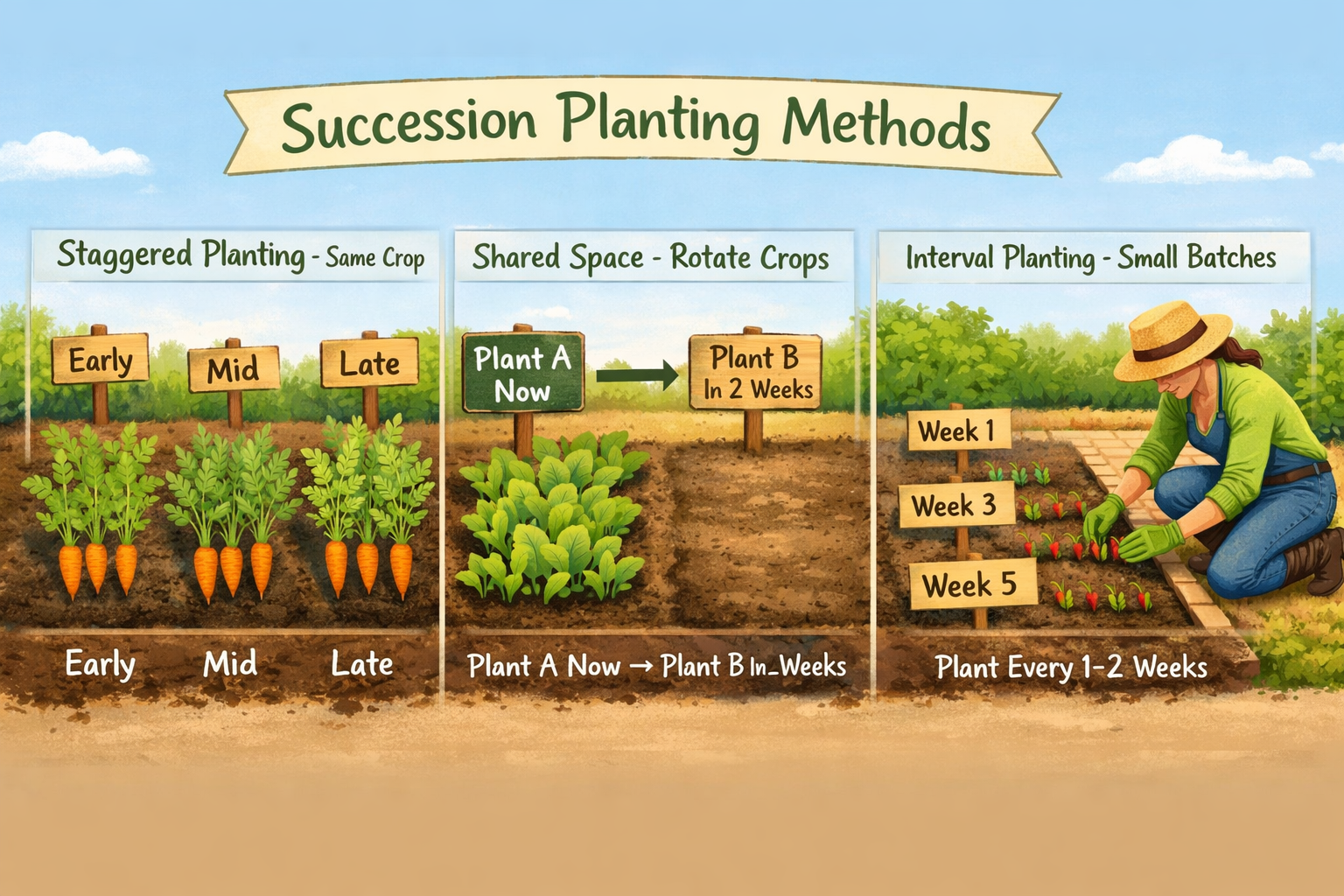
Method 1: Staggered Planting of the Same Crop
This is the most straightforward method, perfect for beginners, and central to answering “what is a succession planting schedule for beginners (what and when)?”. Instead of planting an entire packet of seeds at once, you divide the seeds into smaller batches and plant them over time.
- How it Works: Plant a small section (e.g., 2-3 feet of a row or a single container) of a specific crop, like lettuce, every 7 to 21 days [2].
- Benefit: Ensures a continuous, manageable harvest without an overwhelming glut. As one batch is harvested, the next is nearing maturity.
- Best for: Radishes, lettuce, spinach, cilantro, bush beans.
Quick Example: If you have a 10-foot row for carrots, plant 2 feet of the row every two weeks. By the time the fifth section is planted, the first section will be ready for harvest.
Method 2: Planting Varieties with Different Maturity Dates
This method involves planting several varieties of the same vegetable that have naturally different “days to maturity,” all at the same time.
- How it Works: Select early-maturing, mid-season, and late-maturing varieties of a single crop (e.g., different types of corn, beans, or tomatoes). Plant them all simultaneously at the beginning of the season.
- Benefit: Provides a staggered harvest from a single planting effort, without needing to return to plant every few weeks.
- Best for: Crops with many available varieties, such as corn, peas, or potatoes. This is also effective for vegetables that are less suited to repeated small plantings.
Decision Rule: Choose this method if you prefer a single large planting day and want to minimize repeat planting tasks, especially for crops that take longer to establish.
Method 3: “Cut and Come Again” Harvesting
While not strictly a planting schedule, this harvesting technique complements succession planting by extending the yield from individual plants.
- How it Works: For crops like lettuce, spinach, kale, and some herbs, instead of pulling the entire plant, you harvest only the outer leaves or cut the plant a few inches above the soil line. The plant then regrows, providing another harvest.
- Benefit: Maximizes yield from each plant and stretches the time between successive plantings.
- Best for: Leafy greens and many herbs.
Method 4: “Half and Half” or Interplanting
This method is particularly effective for small space gardening and is a smart way to manage limited plots [1].
- How it Works: Plant half of a garden bed or row with a crop, and two weeks later, plant the second half in the same bed [1]. Alternatively, interplant a fast-maturing crop between slower-growing ones. For example, plant radishes between rows of cabbage; the radishes will be harvested before the cabbage needs the space.
- Benefit: Maximizes limited garden space by keeping it continuously productive. It’s an excellent technique for urban gardeners or those with balcony gardens.
- Best for: Any garden with limited space, pairing fast-growing with slower-growing crops.
Common Mistake: Many beginners plant an entire row or bed with one crop, leaving no room for subsequent plantings or interplanting. Planning for the “half and half” method from the start optimizes space.
Planning Your First Succession Planting Schedule (Step-by-Step for 2026)
Creating your first succession planting schedule doesn’t have to be complicated. By breaking it down into manageable steps, you can confidently plan for continuous harvests throughout 2026.
Step 1: Know Your Last and First Frost Dates
Your local frost dates are the foundation of your entire planting schedule. These dates define the boundaries of your gardening season.
- Action: Research your average last spring frost date and average first fall frost date for your specific region. Many online resources and local extension offices provide this information.
- Why it Matters: Cool-season crops can go in before the last spring frost, while warm-season crops must wait until after. The first fall frost dictates your final planting deadlines [1].
Step 2: Choose Your Crops and Determine Days to Maturity
As a beginner, stick to 3-5 reliable, fast-maturing crops.
- Action: Select a few crops like lettuce, radishes, and green beans [1]. Look up their “days to maturity” on the seed packet or plant tag.
- Why it Matters: This number is crucial for calculating planting intervals and end-of-season deadlines.
Step 3: Map Out Your First Plantings (Early Spring 2026)
Based on your last frost date, plan your initial sowings.
- Action:
- Cool-Season Crops: 2-3 weeks before your last frost, plant your first small batch of radishes and lettuce [1].
- Warm-Season Crops: After your last frost (and when soil warms to 60°F), plant your first small batch of green beans.
- Recommendation: Start with just 2-3 feet of row for each crop, or 1-2 pots per crop [1].
Step 4: Schedule Your Subsequent Plantings
This is where the “succession” comes in!
- Action: Set a recurring reminder for every 2-3 weeks to plant your next small batch of each chosen crop [1].
- Example for Lettuce (45-day maturity):
- April 15: Plant 2 ft row of Lettuce Batch 1
- May 1: Plant 2 ft row of Lettuce Batch 2
- May 15: Plant 2 ft row of Lettuce Batch 3
- …and so on, until your last planting deadline.
- Example for Lettuce (45-day maturity):
- Why it Matters: Consistency is key to a continuous harvest.
Step 5: Plan for Fall Plantings
Don’t forget to leverage your season for a fall harvest!
- Action: Count backward from your first fall frost date. For example, if your first frost is October 15 and lettuce needs 45 days, your last planting should be around September 1 [1]. Continue planting cool-season crops throughout late summer for fall harvests [1].
- Tip: Cool-season crops often taste sweeter after a light frost.
Step 6: Document Everything! ✍️
This step is often overlooked but is vital for learning and improvement.
- Action: Keep a simple garden journal or use a calendar to record what you planted, where you planted it, and the date [1]. Note germination rates, harvest dates, and any observations.
- Why it Matters: This data will be invaluable for refining your schedule next year, helping you understand what works best in your specific garden.
Step 7: Manage Water and Nutrients
New succession plantings, especially seedlings, need consistent care.
- Action: Ensure new seedlings receive weekly watering to help them establish [1]. Depending on your soil, you might need to replenish nutrients, especially in containers, as the season progresses. For basic plant care, refer to our Beginner’s Guide to Plant Care 2026.
- Why it Matters: Healthy starts lead to productive harvests.
Common Mistakes to Avoid in Succession Planting
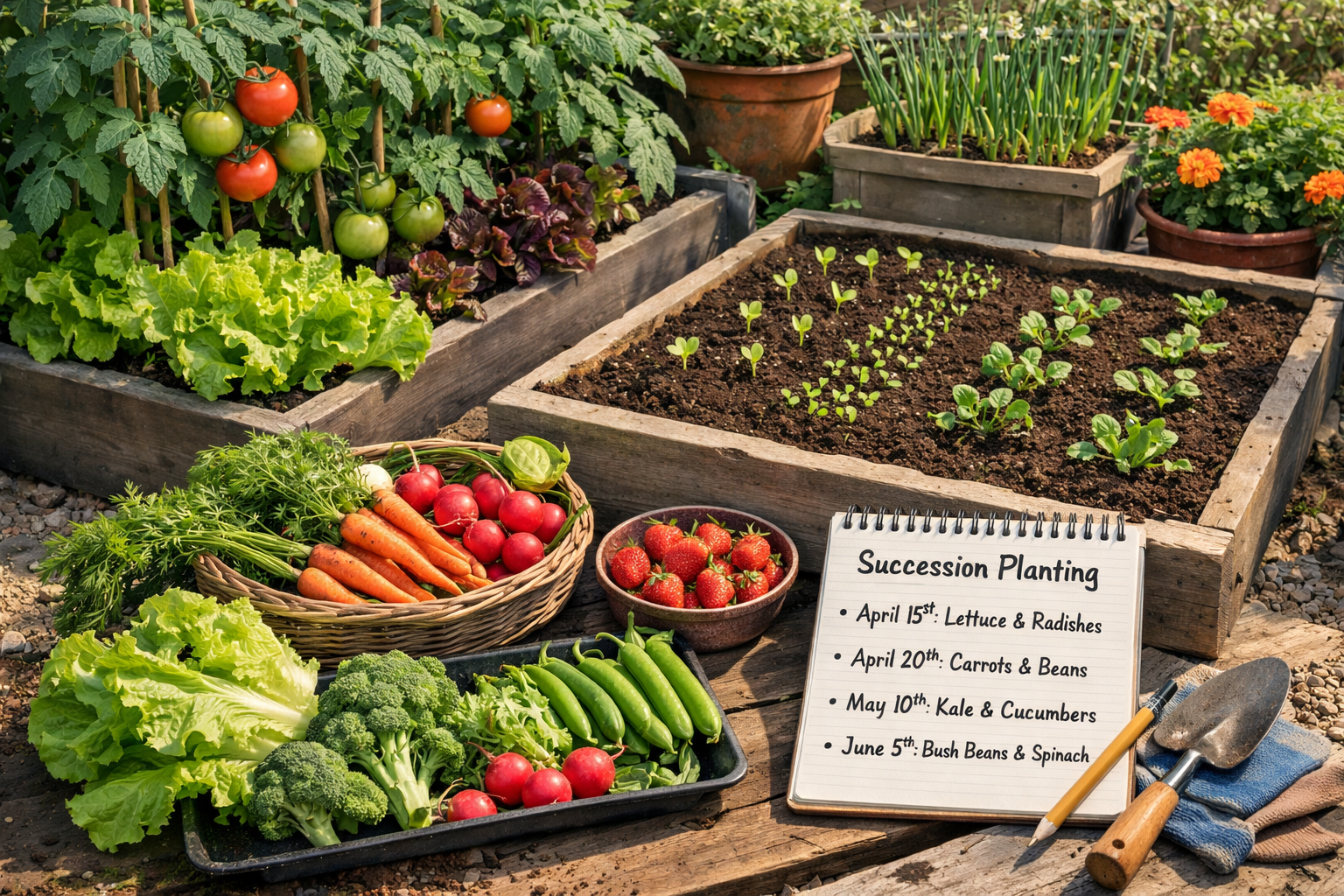
While succession planting is incredibly rewarding, beginners can sometimes fall into common traps that reduce their success. Being aware of these pitfalls will help you maintain a continuous, bountiful garden.
Mistake 1: Planting Too Much at Once
The most frequent error for beginners is overestimating consumption and planting an entire seed packet in one go, even when intending to succession plant [1].
- Why it Happens: Enthusiasm and the desire for a big harvest can lead to planting more than needed.
- The Consequence: This creates a glut of produce that ripens simultaneously, leading to waste, spoilage, or overwhelming preservation efforts [1]. You lose the continuous harvest benefit and might get discouraged.
- Solution: Start with small, manageable amounts – think 2-3 feet of row for ground planting or a single pot for container gardening [1]. Gradually increase the quantity as you learn your family’s needs.
Mistake 2: Forgetting to Document Planting Dates
Without a record, it’s easy to lose track of when you planted what, making it difficult to plan the next succession or learn from your experiences [1].
- Why it Happens: Forgetting to jot down quick notes, especially in the busy early season.
- The Consequence: You might accidentally plant too soon or too late, or harvest a batch before the next is ready, creating gaps in your supply. You also lose valuable data for planning future seasons.
- Solution: Use a dedicated garden journal, a simple notebook, or even a calendar to record what you planted, the date, and its location [1]. This is crucial for refining your “what is a succession planting schedule for beginners (what and when)?” strategy.
Mistake 3: Neglecting Soil Health Between Plantings
Continuous cropping can deplete soil nutrients, especially in raised beds and containers, impacting subsequent plantings.
- Why it Happens: Focusing solely on planting and harvesting without considering the long-term health of the growing medium.
- The Consequence: Future successions may show stunted growth, poor yields, or increased susceptibility to pests and diseases due to nutrient deficiencies.
- Solution: Amend your soil with compost or a balanced organic fertilizer after harvesting a crop and before planting the next. In containers, consider refreshing the top few inches of soil or adding slow-release fertilizers. Learn more about Soil Basics for Container Gardening: 2026 Expert Guide.
Mistake 4: Not Considering Sunlight and Seasonality
Ignoring the changing angle and intensity of the sun throughout the season, or planting warm-season crops during cool periods and vice-versa.
- Why it Happens: Lack of awareness about how light and temperature affect plant growth cycles.
- The Consequence: Crops can bolt prematurely in intense summer sun (e.g., lettuce), or fail to thrive if planted in too-cold or too-hot conditions.
- Solution: Match crops to the season. Plant cool-season crops in spring and late summer/fall. Reserve the hottest parts of summer for heat-tolerant plants or provide shade for cool-season crops. Use cool-season crops like radishes and spinach for late-summer plantings for fall harvests, as they can handle light frost [1].
Mistake 5: Giving Up After a Failed Planting
Gardening involves trial and error. A setback with one succession can be discouraging.
- Why it Happens: Expecting perfection from every planting, especially as a beginner.
- The Consequence: Missing out on the learning experience and the eventual success that comes from persistence.
- Solution: View each planting as an experiment. If a batch doesn’t thrive, analyze what might have gone wrong (e.g., watering, weather, timing) and adjust for the next succession. The beauty of succession planting is you always have another chance coming up! For more guidance, explore Beginner Mistakes in Small Space Gardening 2026.
Conclusion
Mastering what is a succession planting schedule for beginners (what and when)? is a powerful way to transform your gardening experience from sporadic harvests to a continuous bounty. By embracing fast-maturing crops, understanding your local frost dates, and staggering your plantings every 2-3 weeks, you can ensure a steady supply of fresh vegetables throughout the 2026 growing season. Remember to start small, document your efforts, and learn from each successive planting. This patient and methodical approach will not only maximize your garden’s output but also deepen your connection to the rhythms of nature.
Actionable Next Steps:
- Identify Your Frost Dates: Pinpoint your average last spring frost and first fall frost dates for 2026.
- Select Starter Crops: Choose 2-3 beginner-friendly, fast-maturing vegetables like radishes, lettuce, or bush beans.
- Create a Simple Calendar: Mark your initial planting dates and subsequent 2-3 week intervals for your chosen crops on a physical or digital calendar.
- Start Small: Plant a very modest amount for your first succession (e.g., 2 feet of a row or a single container).
- Document: Begin a garden journal to record planting dates, varieties, and observations.
By following these steps, you’ll be well on your way to enjoying a continuous, homegrown harvest all season long. Happy gardening in 2026!
FAQ
What is the primary goal of succession planting?
The primary goal of succession planting is to ensure a continuous harvest of vegetables throughout the growing season, preventing an overwhelming glut of produce at one time and subsequent periods of scarcity [2, 5].
How often should beginners plant for succession?
Beginners should aim to plant small batches of crops every 2-3 weeks to maintain a continuous supply, with faster-maturing crops like radishes sometimes planted every two weeks [1].
Which crops are easiest for a beginner’s succession planting schedule?
Radishes, lettuce and salad greens, and bush green beans are excellent choices for beginners due to their fast maturity times (25-60 days) [1].
When should I stop succession planting for the season?
You should stop succession planting by counting backward from your average first fall frost date using the crop’s “days to maturity,” plus a small buffer for slower fall growth [1].
Can I do succession planting in a small garden or containers?
Yes, succession planting is highly effective for small gardens and containers, especially using methods like the “half and half” strategy to maximize limited space [1].
What is the “half and half” succession planting method?
The “half and half” method involves planting half of a row or bed with a crop, and then planting the other half in the same space two weeks later, ensuring staggered maturity [1].
Why is documentation important for succession planting?
Documenting planting dates, varieties, and locations helps you track progress, learn what works best, and plan future succession plantings more effectively [1].
What is a common mistake beginners make in succession planting?
A common mistake is planting too much at once, leading to an excessive harvest and potential waste; starting with small amounts (2-3 feet of row) is recommended [1].
Do cool-season crops offer any special advantages for succession planting?
Cool-season crops like lettuce and radishes can be planted earlier in spring and continued into late summer for fall harvests, as they can tolerate light frosts [1].
What is the ideal soil temperature for planting warm-season succession crops?
Warm-season succession crops like green beans and summer squash should be planted when soil temperatures consistently reach 60°F (15°C) or higher, typically after the last frost date [1].
References
[1] Succession Planting Calendar – https://www.elmdirt.com/blogs/news/succession-planting-calendar
[2] Succession Planting How To Grow A Constant Harvest – https://migardener.com/blogs/blog/succession-planting-how-to-grow-a-constant-harvest
[3] Succession Planting – https://extension.wvu.edu/lawn-gardening-pests/gardening/garden-management/succession-planting
[4] Your 2026 Garden Starting With A Year Round Yield Plan – https://www.starkeayres.com/news/your-2026-garden-starting-with-a-year-round-yield-plan
[5] Extend Your Growing Season And Maximize Your Harvests With Successive Sowing – https://www.gardenary.com/blog/extend-your-growing-season-and-maximize-your-harvests-with-successive-sowing
[6] Succession Planting How To Keep The Harvest Going All Season Long – https://www.floretflowers.com/succession-planting-how-to-keep-the-harvest-going-all-season-long/
[7] The Secret To Double Or Triple Your Garden Harvest A Printable To Help You Plan It All Out – https://midatlantichomestead.com/the-secret-to-double-or-triple-your-garden-harvest-a-printable-to-help-you-plan-it-all-out/
[8] Succession Planting Guide – https://sandiegoseedcompany.com/growing/succession-planting-guide/
[9] Gardening – https://www.farmersalmanac.com/calendar/gardening