Low Maintenance Plants for Beginners: A Complete Guide to Easy-Care Houseplants in 2026
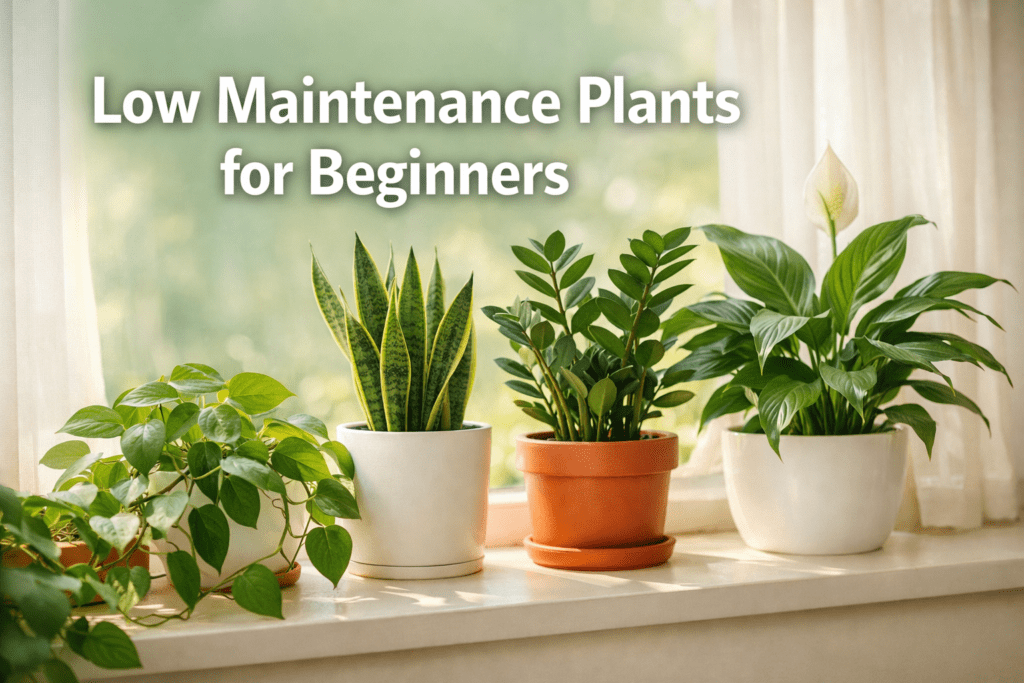
You don’t need a green thumb to keep houseplants alive. The right plant, placed in the right spot, with water every week or two, is genuinely all it takes. I’ve watched dozens of first-time plant owners go from “I kill everything” to proudly showing off a thriving collection, and the difference almost always comes down to choosing low maintenance plants for beginners instead of fussy species that punish small mistakes. This guide covers exactly which plants to start with, how to care for them, and which common errors to avoid.
Key Takeaways
- Pothos, snake plants, and ZZ plants are the three most forgiving starter plants because they tolerate inconsistent watering, low light, and general neglect [1][3].
- Most beginner-friendly plants need watering only every 1–2 weeks, not daily.
- Overwatering kills more houseplants than underwatering. When in doubt, wait another day.
- You don’t need expensive soil, grow lights, or fertilizer to get started. A pot with drainage and indirect light from a window is enough.
- Spider plants and pothos produce offshoots you can propagate for free, so one plant can become many.
Quick Answer
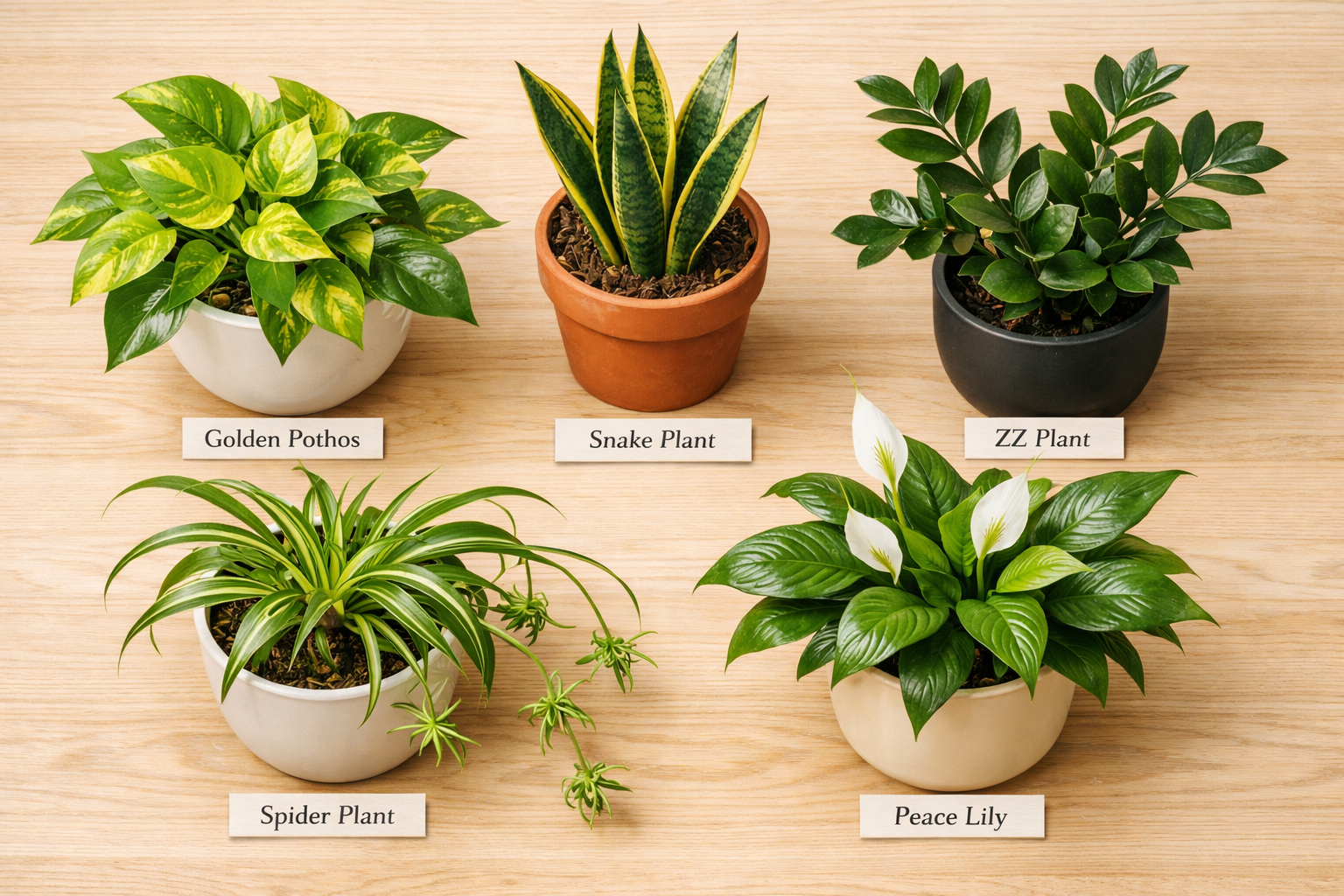
The best low maintenance plants for beginners are pothos, snake plants, ZZ plants, peace lilies, and spider plants. These species tolerate low light, need infrequent watering (every 7–14 days), and recover well from missed care. Start with one or two, place them near a window with indirect sunlight, water only when the top inch of soil feels dry, and use pots with drainage holes.
What Makes a Plant “Low Maintenance” for Beginners?
A low maintenance plant is one that survives common beginner mistakes: irregular watering, imperfect lighting, and occasional neglect. These plants share a few traits that make them forgiving.
Key characteristics of easy-care houseplants:
- Drought tolerance — They store water in thick leaves or roots, so missing a watering session doesn’t cause immediate damage.
- Light flexibility — They grow in a range of conditions from low light to bright indirect light, meaning you don’t need a south-facing window or grow lamps.
- Slow to show stress — Rather than wilting overnight, they give you visual cues (yellowing leaves, drooping) with enough time to correct course.
- Pest resistance — Hardy species attract fewer common pests like fungus gnats and spider mites.
Choose a low maintenance plant if: you travel often, forget to water, live in an apartment with limited natural light, or simply want to build confidence before graduating to more demanding species.
Skip this category if: you’re specifically looking for fast-growing flowering plants or edible herbs, which generally require more consistent attention. That said, even experienced growers keep a few easy-care plants around because they’re reliable and attractive.
If you’re working with a small apartment or balcony, our guide to small space gardening covers layout strategies that pair well with the plants listed below.
Which Low Maintenance Plants for Beginners Should You Start With?
Start with one of these seven species. Each one is widely available at garden centers and big-box stores, typically costs between $5 and $20, and has a strong track record of surviving beginner care.
1. Pothos (Devil’s Ivy)
Pothos consistently ranks as the number one beginner plant across gardening guides, and for good reason: it’s “practically indestructible” [1][2]. It grows as a trailing vine with heart-shaped leaves, looks great on shelves or in hanging baskets, and adapts to almost any indoor environment.
- Light: Low to bright indirect light
- Water: When the top inch of soil is dry (roughly every 7–10 days)
- Bonus: Can grow in just water — no soil needed [2]
- Common varieties: Golden pothos, marble queen, neon pothos
Pothos is often called the “starter plant” because it visually tells you what it needs: drooping leaves mean it’s thirsty, and yellow leaves mean you’re overwatering.
2. Snake Plant (Sansevieria)
Snake plants are architectural, upright, and almost impossible to kill through neglect. They store water in their thick, sword-shaped leaves, so they handle drought well. They also tolerate both bright indirect light and dim corners [1][5].
- Light: Bright indirect to low light
- Water: Every two weeks, only when soil is mostly dry [5]
- Soil: Well-drained potting mix (add perlite if needed)
- Watch out for: Overwatering, which causes root rot faster than in most plants
3. ZZ Plant (Zamioculcas zamiifolia)
The ZZ plant has glossy, dark green leaves and a reputation for thriving on neglect. It’s been described as “almost impossible to overwater or undertake” [1][3], though overwatering is still the most common way people damage it.
- Light: Low to moderate indirect light
- Water: Only after soil completely dries out (every 2–3 weeks)
- Growth: Slow but steady; new shoots emerge from the base
- Ideal for: Offices, bathrooms, and rooms with small windows
4. Peace Lily (Spathiphyllum)
Peace lilies are one of the few low-light plants that also flower. They produce white blooms and have been noted for improving indoor air quality [1][2]. They prefer consistently moist soil but will dramatically droop when thirsty, then bounce back within hours of watering.
- Light: Low to medium indirect light
- Water: Weekly, keeping soil moist but not soggy [2]
- Note: Mildly toxic to cats and dogs if ingested, so place on a high shelf if you have pets
5. Spider Plant (Chlorophytum comosum)
Spider plants are cheerful, fast-growing, and produce “spiderettes” — baby plants that dangle from the mother plant on long stems. You can cut these off and replant them once they develop small roots [5], which makes spider plants a great way to grow your collection for free.
- Light: Bright indirect light (tolerates medium light)
- Water: When the top inch of soil is dry
- Bonus: Non-toxic to pets
- Common issue: Brown leaf tips, usually caused by fluoride in tap water (switch to filtered water if this happens)
6. Air Plants (Tillandsia)
Air plants don’t need soil at all. They absorb water and nutrients through their leaves, which makes them a novelty for beginners who want something different. One guide calls them “the easiest plant to care for” [2], though they do need a specific watering method.
- Light: Indirect sunlight, placed 3–5 feet from a window [2]
- Water: Soak in water for 10–20 minutes once a week, then shake off excess and let dry upside down
- Display: Mount on driftwood, place in glass terrariums, or set on a shelf
7. Jade Plant (Crassula ovata)
Jade plants are succulents with thick, oval leaves and woody stems. They grow slowly into small tree-like shapes and can live for decades with minimal care. They’re a solid choice if you tend to forget watering entirely [5].
- Light: Bright indirect to direct light (a sunny windowsill is ideal)
- Water: Every 2–3 weeks; let soil dry completely between waterings
- Longevity: With proper care, jade plants can live 50+ years
Comparison Table: Low Maintenance Plants for Beginners at a Glance
| Plant | Light Needs | Watering Frequency | Pet Safe? | Difficulty |
|---|---|---|---|---|
| Pothos | Low to bright indirect | Every 7–10 days | No | Very easy |
| Snake Plant | Low to bright indirect | Every 14 days | No | Very easy |
| ZZ Plant | Low to moderate indirect | Every 14–21 days | No | Very easy |
| Peace Lily | Low to medium indirect | Weekly | No | Easy |
| Spider Plant | Bright indirect | Every 7–10 days | Yes | Easy |
| Air Plant | Indirect, 3–5 ft from window | Weekly soak | Yes | Easy |
| Jade Plant | Bright indirect to direct | Every 14–21 days | No | Easy |
How Do You Care for Low Maintenance Plants for Beginners?
Even easy-care plants need a few basics done right. Here’s a simple weekly routine that works for most of the plants listed above.
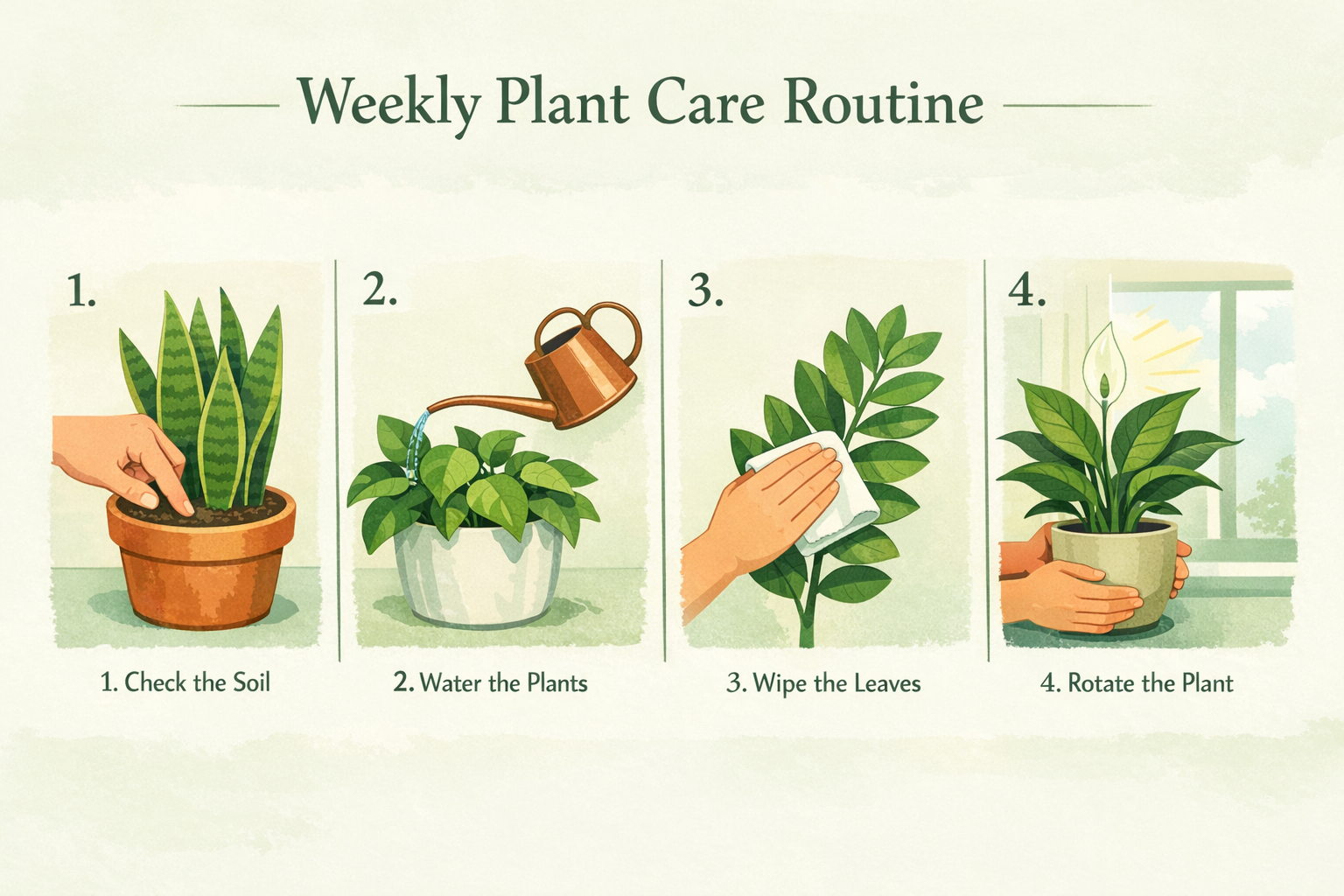
Step-by-Step Weekly Care Checklist
- Check soil moisture. Stick your finger about one inch into the soil. If it feels dry, water. If it’s still damp, wait 2–3 more days.
- Water thoroughly. Pour water slowly until it drains from the bottom of the pot. Empty the saucer after 30 minutes so the roots aren’t sitting in standing water.
- Rotate the pot. Give it a quarter turn so all sides get even light exposure. This prevents lopsided growth.
- Wipe leaves. Dust blocks light absorption. A damp cloth across each leaf every couple of weeks keeps the plant healthy.
- Look for problems. Yellow leaves, brown spots, or tiny insects are early warning signs. Catching issues early is much easier than treating advanced problems.
Watering: The Single Most Important Skill
Overwatering is the leading cause of houseplant death among beginners. The instinct is to water frequently because you want to “take care” of the plant, but most low maintenance species prefer to dry out between waterings.
Decision rule:
- If the soil feels moist at one inch deep, don’t water.
- If the soil feels dry at one inch deep, water thoroughly.
- If you’re unsure, wait one more day. These plants handle drought far better than soggy roots.
For anyone setting up a small indoor garden, our small space gardening resource hub has additional tips on organizing pots and managing watering schedules in tight spaces.
What Are the Most Common Mistakes Beginners Make with Houseplants?
Most plant failures come from a handful of predictable errors. Here’s what to watch for.
Mistake 1: Overwatering
As mentioned above, this is the number one killer. Root rot sets in when soil stays wet for too long, and by the time you notice mushy stems or a foul smell, the damage is often irreversible.
Fix: Use pots with drainage holes. Always check soil moisture before watering. Choose well-draining potting mix, especially for snake plants and ZZ plants [1][5].
Mistake 2: Too Little Light (or Too Much Direct Sun)
“Low light” doesn’t mean “no light.” Even shade-tolerant plants like ZZ plants need some indirect light to photosynthesize. On the flip side, placing a peace lily in direct afternoon sun will scorch its leaves.
Fix: Place plants within 3–8 feet of a window. North-facing windows provide gentle, consistent light. East-facing windows offer morning sun, which most beginner plants handle well.
Mistake 3: Using Pots Without Drainage
Decorative pots without holes trap water at the bottom, creating conditions for root rot even if you’re careful about watering amounts.
Fix: Keep plants in their nursery pots (which have drainage) and set those inside decorative outer pots. Or drill a hole in the bottom of ceramic pots.
Mistake 4: Repotting Too Soon
New plant owners often repot immediately after buying. This stresses the plant during an already stressful transition to a new environment.
Fix: Wait at least 2–4 weeks before repotting. When you do repot, go up only one pot size (about 1–2 inches larger in diameter).
Mistake 5: Ignoring Humidity
Peace lilies and air plants appreciate humidity, while snake plants and jade plants prefer drier air. Grouping humidity-loving plants together or placing them near a kitchen or bathroom can help.
Where Should You Place Low Maintenance Plants in Your Home?
Placement matters more than most beginners realize. The right spot can mean the difference between a plant that thrives and one that slowly declines.
Room-by-room suggestions:
- Living room (near a window): Pothos on a high shelf where it can trail, snake plant in a floor pot beside furniture
- Bedroom: Snake plant or ZZ plant, both of which tolerate the typically lower light levels of bedrooms
- Bathroom: Peace lily or air plant, which benefit from the natural humidity after showers
- Kitchen: Spider plant on a windowsill above the sink, jade plant on a sunny counter
- Office or desk: Small ZZ plant or pothos in a tabletop pot; both handle fluorescent lighting
If you’re working with a balcony or limited floor space, check out our ultimate guide to small space gardening for beginners for layout ideas that maximize your growing area.
Common edge case: If your apartment has no windows or only a single north-facing window, stick with ZZ plants and pothos. These two handle the lowest light conditions of any common houseplant [1][3]. You can supplement with a basic LED grow light (available for under $20) if growth stalls completely.
How Much Do Beginner Houseplants Cost?
Getting started with houseplants is inexpensive. Here’s a realistic breakdown.
| Item | Estimated Cost |
|---|---|
| Pothos (4-inch pot) | $5–$10 |
| Snake plant (6-inch pot) | $10–$20 |
| ZZ plant (6-inch pot) | $12–$25 |
| Basic potting soil (8 qt bag) | $5–$8 |
| Nursery pot with drainage (3-pack) | $5–$10 |
| Watering can | $5–$15 |
| Total to start with 1–2 plants | $20–$50 |
You can reduce costs further by propagating. Pothos cuttings root in water within 2–3 weeks, and spider plant babies can be snipped and potted for free [5]. One $8 pothos can become five plants within a few months.
Can You Grow Low Maintenance Plants in Low Light?
Yes, several beginner plants grow well in low light, though “low light” in plant terms means indirect light from a nearby window, not a dark closet.
Best low-light options:
- ZZ plant — Thrives in low to moderate indirect light [3]
- Pothos — Adapts to low light, though growth slows and variegation may fade [1]
- Snake plant — Handles dim corners better than most plants [1]
- Peace lily — Prefers low to medium indirect light and will still bloom in these conditions [2]
What “low light” actually means: The plant receives no direct sunlight but is in a room with a window. If you can comfortably read a book by natural light in that spot, it’s bright enough for these species.
For creative ways to position plants in small or dimly lit spaces, our small space gardening ideas page offers practical solutions.
How Do You Know When Something Is Wrong with Your Plant?
Plants communicate through their leaves. Here’s a quick diagnostic guide.
| Symptom | Likely Cause | Fix |
|---|---|---|
| Yellow leaves | Overwatering or too much direct sun | Reduce watering; move to indirect light |
| Brown, crispy leaf tips | Low humidity or underwatering | Mist leaves or water more consistently |
| Drooping leaves | Underwatering (or overwatering if soil is wet) | Check soil; water if dry, reduce if wet |
| Leggy, stretched growth | Not enough light | Move closer to a window |
| White fuzzy spots | Mealybugs | Wipe with rubbing alcohol on a cotton swab |
| Mushy stem base | Root rot from overwatering | Remove from pot, trim rotten roots, repot in dry soil |
Quick rule: When a plant looks unhealthy, check the soil moisture first. About 80% of beginner plant problems trace back to watering issues.
Are Any of These Plants Safe for Pets?
This matters if you have cats or dogs. Many popular houseplants are mildly toxic if chewed or ingested.
Pet-safe options from this list:
- Spider plant
- Air plant
Mildly toxic to pets (keep out of reach):
- Pothos
- Snake plant
- ZZ plant
- Peace lily
- Jade plant
“Mildly toxic” typically means ingestion causes mouth irritation, drooling, or vomiting, not life-threatening poisoning. But if you have a pet that chews on everything, stick with spider plants and air plants, or place other species on high shelves or in hanging planters.
FAQ: Low Maintenance Plants for Beginners
What is the easiest houseplant to keep alive?
Pothos is widely considered the easiest houseplant for beginners. It tolerates low light, inconsistent watering, and can even grow in a jar of water with no soil [1][2].
How often should I water low maintenance plants?
Most beginner plants need water every 7–14 days. Always check soil moisture before watering rather than following a rigid schedule, because factors like humidity, pot size, and season affect how quickly soil dries.
Do I need to fertilize beginner plants?
Not right away. Most potting soil contains enough nutrients for the first 6–12 months. After that, a balanced liquid fertilizer diluted to half strength once a month during spring and summer is sufficient.
Can I keep houseplants in a room with no windows?
Not long-term. All plants need some light for photosynthesis. If you have no natural light, use a basic LED grow light on a timer for 10–12 hours per day. ZZ plants and pothos tolerate the lowest natural light levels [1][3].
Why are my pothos leaves turning yellow?
The most common cause is overwatering. Check that the pot has drainage holes and that you’re letting the top inch of soil dry between waterings. Less frequently, yellow leaves can indicate too much direct sunlight.
Are succulents good for beginners?
Succulents like jade plants are good for beginners who tend to underwater, because they store moisture in their leaves. However, they need more light than pothos or ZZ plants, so they’re best near a sunny window [5].
How do I propagate a spider plant?
Wait until the spiderettes (baby plants dangling from the mother plant) develop small roots at their base. Cut the stem connecting them to the mother plant and place them in moist soil or water until roots establish [5].
What size pot should I use?
Start with the pot the plant came in. When roots start growing out of the drainage holes (usually after 1–2 years), move up to a pot that’s 1–2 inches larger in diameter.
Do houseplants really clean the air?
NASA’s 1989 Clean Air Study found that certain plants, including peace lilies and pothos, can remove some volatile organic compounds from air in sealed chambers. In a normal home with ventilation, the air-purifying effect is modest, but peace lilies are still noted for this benefit [1][2].
Can I grow these plants in an office with fluorescent lights?
Yes. Pothos, ZZ plants, and snake plants all tolerate fluorescent lighting. They won’t grow as fast as they would near a window, but they’ll survive and look healthy.
What’s the best soil for beginner houseplants?
A standard indoor potting mix works for most species on this list. For snake plants, ZZ plants, and jade plants, mix in extra perlite (about 1 part perlite to 3 parts potting soil) to improve drainage [5].
Conclusion
Growing houseplants doesn’t require experience, expensive equipment, or a perfect living space. The seven plants covered in this guide — pothos, snake plant, ZZ plant, peace lily, spider plant, air plant, and jade plant — have earned their reputations as low maintenance plants for beginners because they tolerate the kinds of mistakes every new grower makes.
Your actionable next steps:
- Pick one plant from this list based on your light conditions. Low light? Go with a ZZ plant or pothos. Sunny window? Try a jade plant.
- Get a pot with drainage holes and basic indoor potting mix. That’s all you need to start.
- Set a weekly reminder to check soil moisture. Don’t water on autopilot — touch the soil first.
- Observe your plant for the first month. Notice how quickly the soil dries, whether leaves lean toward light, and how the plant responds to your care.
- Add a second plant once you feel confident. Propagate a cutting from your first one if you want to save money.
For more ideas on fitting plants into apartments, balconies, and other compact living areas, explore our complete small space gardening guide and browse additional small space gardening ideas for inspiration.
The best time to start is now. Pick up a pothos this weekend, put it near a window, and water it when the soil feels dry. That’s it. You’re a plant person.
References
[1] Top 5 Low Maintenance Houseplants For Beginners – https://16acresgardencenter.com/2025/01/22/top-5-low-maintenance-houseplants-for-beginners/
[2] Low Maintenance Houseplants For Beginners – https://cluballiance.aaa.com/the-extra-mile/advice/home/low-maintenance-houseplants-for-beginners
[3] Houseplants For Beginners – https://www.swansonsnursery.com/blog/houseplants-for-beginners
[5] Beginner House Plant Tips For Bloomington Indiana College Students – https://www.idsnews.com/article/2025/11/beginner-house-plant-tips-for-bloomington-indiana-college-students