Indoor Gardening for Small Homes & Apartments: Cultivating Green Sanctuaries in 2026
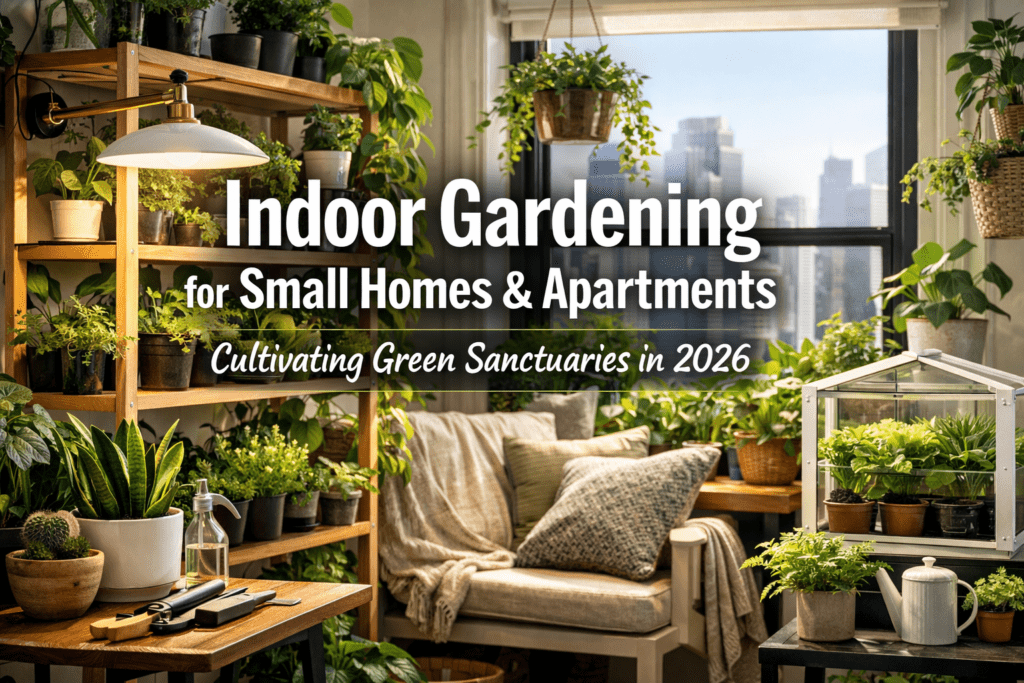
Indoor gardening for small homes and apartments offers a powerful way to integrate nature into confined living spaces, improving well-being and aesthetics. By leveraging vertical space, selecting appropriate low-maintenance plants, and utilizing modern technology like grow lights and smart watering systems, apartment dwellers can cultivate thriving green environments that transform their homes into tranquil, living sanctuaries in 2026.
TL;DR
- Indoor gardening transforms small homes and apartments into vibrant, stress-reducing sanctuaries by utilizing vertical space and smart solutions.
- Focus on statement plants and curated groupings rather than numerous small pots to avoid clutter and enhance aesthetics.
- Low-maintenance plants like Snake Plant and Pothos are ideal for busy dwellers, thriving in typical indoor conditions.
- Smart watering systems and grow lights are essential tools in 2026 for overcoming common challenges like low light and inconsistent watering.
- Integrate plants as living art or functional room dividers to maximize space and enhance modern interior design.
Why Embrace Indoor Gardening for Small Homes & Apartments in 2026?
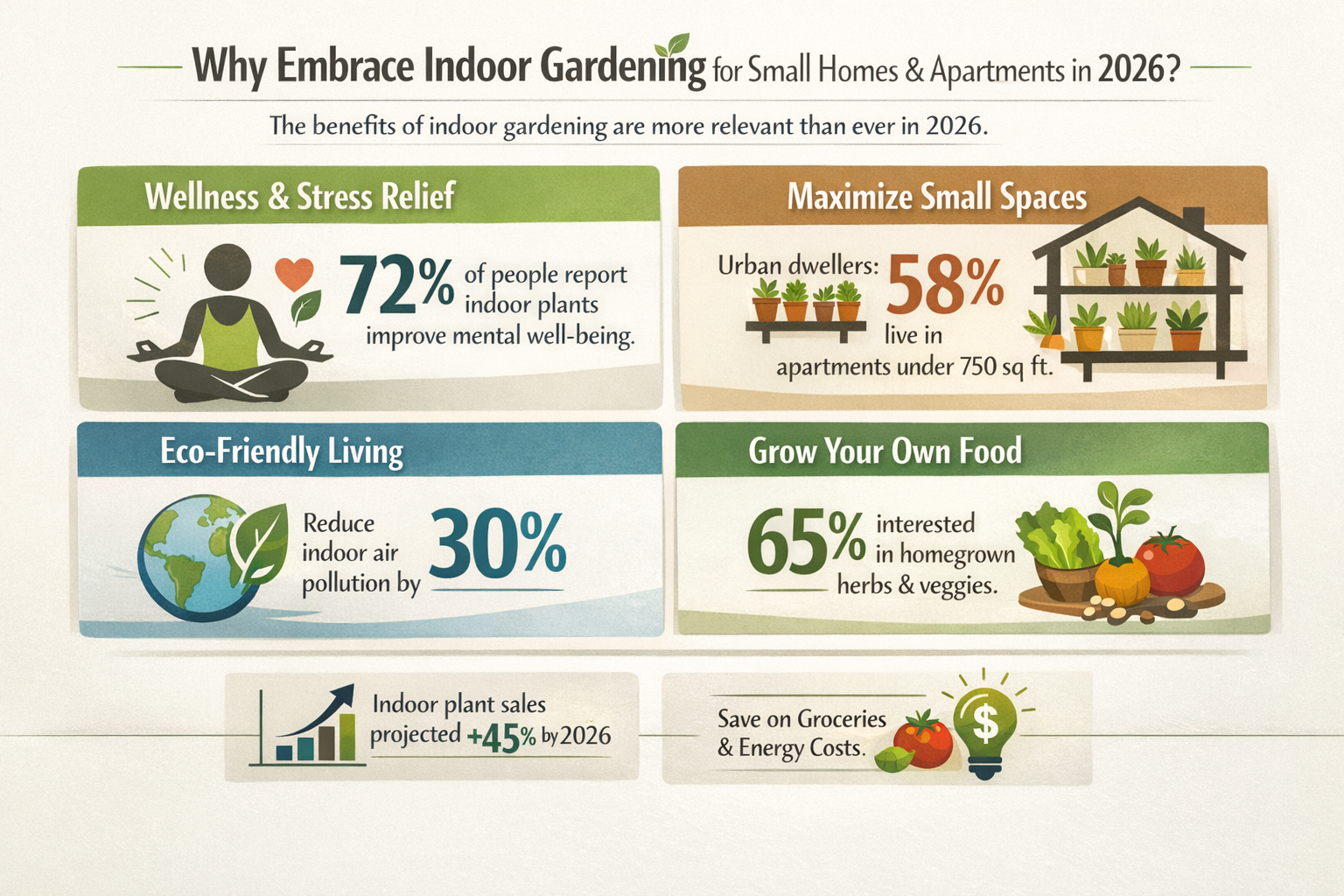
Embracing indoor gardening in small homes and apartments in 2026 provides numerous benefits, from enhancing mental well-being to improving indoor air quality and transforming compact spaces into aesthetically pleasing, living environments. Even with limited square footage, dedicated indoor gardens create a connection to nature that is often missing in urban living, making small spaces feel larger and more inviting.
The drive for nature-integrated interior spaces is stronger than ever, especially in urban environments where access to outdoor green spaces is limited. Wellness research indicates that integrating natural elements can reduce stress by up to 20%, making indoor ecosystems particularly valuable for apartment dwellers seeking a calming sanctuary [4]. Beyond mental health, plants naturally purify the air, removing toxins and increasing oxygen levels, contributing to a healthier indoor atmosphere. Furthermore, indoor gardening for small homes and apartments allows for year-round access to fresh herbs and vegetables, a significant advantage for those focused on sustainable living and healthy eating. This trend is not just about decorating; it’s about cultivating a healthier, more intentional lifestyle within your home [6].
- Boosts Well-being: Connecting with plants reduces stress and improves mood [4].
- Enhances Air Quality: Plants naturally filter indoor air pollutants.
- Aesthetic Appeal: Transforms plain rooms into vibrant, stylish spaces.
- Food Security: Provides fresh herbs and vegetables right in your kitchen.
- Sense of Accomplishment: Nurturing plants offers a rewarding hobby.
Common Mistake: Many beginners try to pack too many small plants into every available corner, leading to visual clutter and making individual plant care difficult. Instead, focus on fewer, larger statement plants or curated groupings to maximize impact and maintain a serene aesthetic [5].
Choosing the Right Plants for Indoor Gardening in Small Spaces
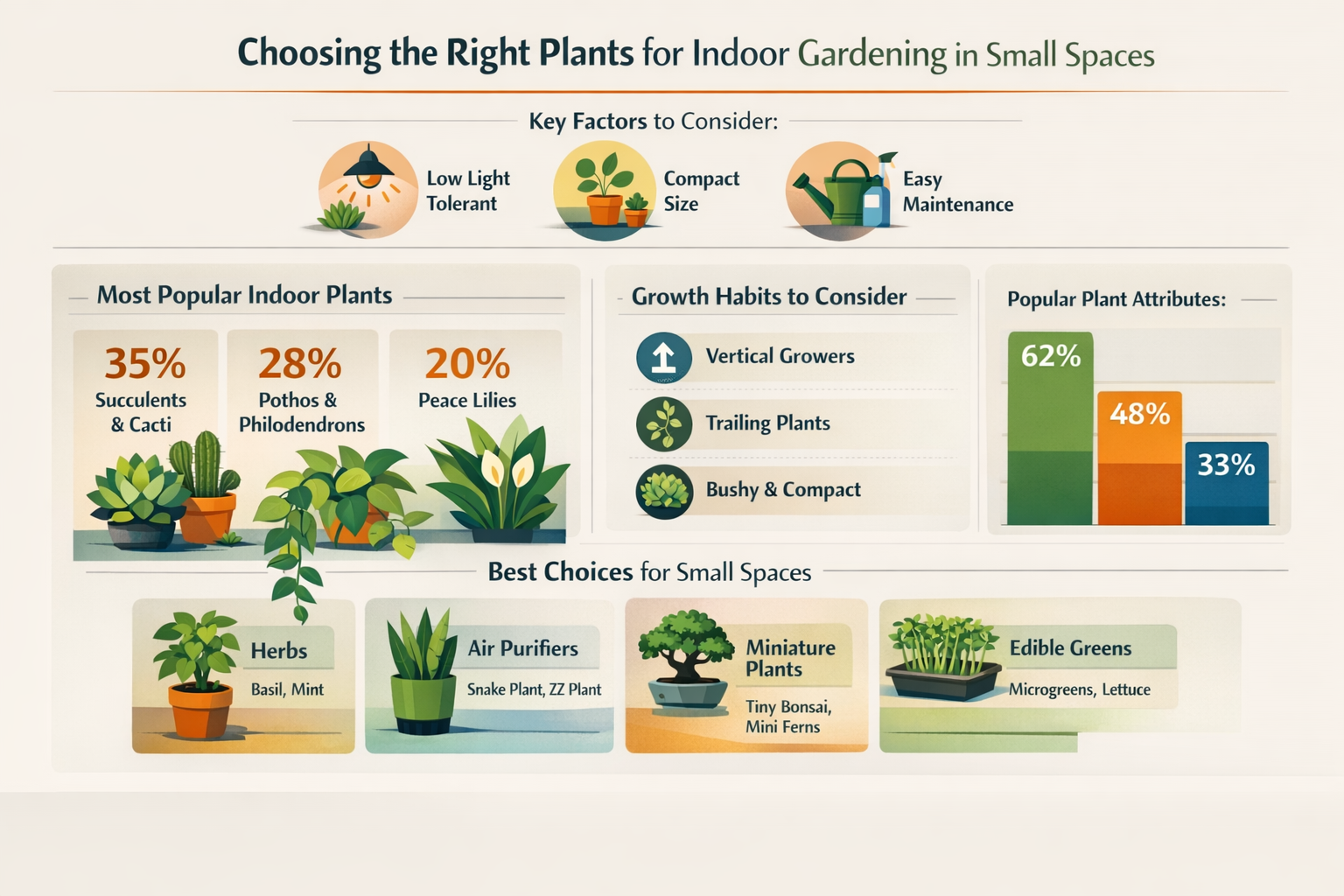
Selecting the appropriate plants is crucial for successful indoor gardening for small homes and apartments, prioritizing species that thrive in typical indoor conditions with limited space and varying light levels. Low-maintenance and resilient plants are often the best choices for busy apartment dwellers, ensuring a beautiful green space without constant demanding care.
For those engaging in indoor gardening for small homes and apartments, modern favorites include the Snake Plant, ZZ Plant, Pothos, Peace Lily, and Rubber Plant, all known for their ability to thrive in a range of indoor light conditions and require minimal watering [2]. These species are particularly suitable because they tolerate lower light levels common in apartments and can withstand occasional neglect, making them ideal for individuals with busy schedules or those new to plant care. Additionally, the trend is shifting towards owning fewer, larger statement plants that function as living art, rather than dozens of small plants that can create visual clutter [5]. Unusual and variegated houseplant varieties are also emerging as collectible items, adding a unique aesthetic element to interior design [1].
Table 1: Top Low-Maintenance Plants for Small Indoor Spaces
| Plant Name | Light Requirements | Watering Frequency | Special Features |
|---|---|---|---|
| Snake Plant | Low to Bright Indirect | Every 2-4 weeks | Air purifying, tolerates neglect, vertical growth ideal for tight spaces. |
| ZZ Plant | Low to Bright Indirect | Every 3-4 weeks | Extremely drought-tolerant, glossy dark green leaves, almost impossible to kill. |
| Pothos | Low to Medium Indirect | Weekly (allow soil to dry) | Trailing vines ideal for hanging baskets or shelves, comes in various variegated forms. |
| Peace Lily | Low to Medium Indirect | Weekly (keep soil moist) | Produces elegant white flowers, air purifying, wilts dramatically when thirsty but recovers quickly. |
| Rubber Plant | Medium to Bright Indirect | Every 1-2 weeks | Large, glossy leaves make a strong statement, can grow quite tall, good air purifier. |
| Prayer Plant | Medium Indirect | Weekly (keep soil moist) | Striking patterned leaves that fold up at night, adds dynamic interest. |
| Monstera Deliciosa | Medium to Bright Indirect | Every 1-2 weeks | Iconic split leaves, can grow large but can be pruned, creates a tropical vibe. |
Decision Rule: Choose a Snake Plant or ZZ Plant if you have minimal natural light and travel frequently. Opt for a Pothos or Peace Lily if you enjoy more frequent interaction and have slightly better light conditions. For those aiming for a bold design statement, a larger Rubber Plant or Monstera might be suitable, provided there’s adequate vertical space and light.
Maximizing Space with Creative Planter & Arrangement Ideas
Maximizing space for indoor gardening for small homes and apartments involves creative planter choices and strategic plant arrangements that utilize verticality and integrate plants seamlessly into your decor. Thinking beyond traditional potted plants allows even the tiniest living areas to flourish with greenery.
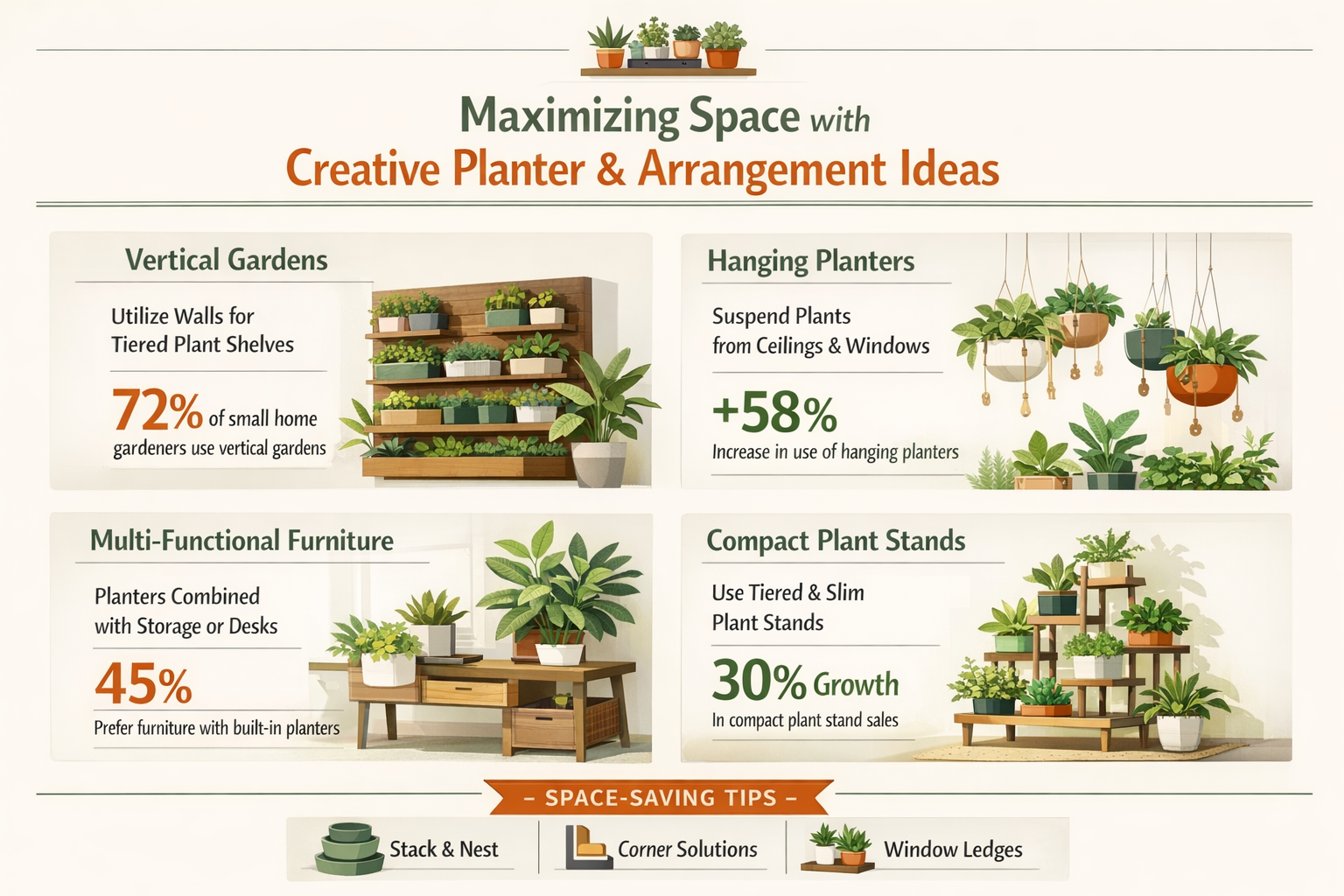
Vertical gardening solutions are dominating in 2026, with living wall art and vertical green walls becoming primary solutions for small-space indoor gardening, transforming wall space into dynamic art exhibitions [1, 2]. These systems allow you to grow multiple plants upwards, freeing up valuable floor and counter space. Additionally, floating shelves with layered greenery offer a contemporary approach, combining functionality with aesthetics by mixing trailing plants with upright foliage in balanced, symmetrical arrangements [2]. Another effective strategy is using tall plants in linear planters or modular plant systems as natural space dividers in open-plan living areas, studio apartments, and home offices, providing privacy without blocking light or airflow [2]. When it comes to aesthetics, modern small-space designs favor matte ceramic, concrete, or stone planters in neutral colors (beige, black, grey) with clean lines and geometric shapes to blend seamlessly with contemporary interiors [2].
Checklist: Creative Space-Saving Arrangements
- ✅ Vertical Gardens: Install wall-mounted planters or modular systems.
- ✅ Floating Shelves: Utilize vertical wall space for tiered plant displays.
- ✅ Hanging Planters: Suspend plants from ceilings or curtain rods, especially trailing varieties.
- ✅ Plant Room Dividers: Use tall, slender plants in linear planters to define zones.
- ✅ Corner Groupings: Apply the “Rule of Three” – group three plants of different heights to create intentional “wellness nooks” [5].
- ✅ Under-Shelf Lighting: Integrate LED grow lights discreetly under shelves to support plants in darker spots.
- ✅ Tiered Plant Stands: Use multi-level stands to hold several plants in a small footprint.
- ✅ Window Sill Gardens: Maximize natural light with compact herb or succulent arrangements.
Quick Example: In a studio apartment, a sleek, floor-to-ceiling vertical garden behind the sofa not only displays a variety of foliage and herbs but also acts as a stunning backdrop, creating an immersive ecosystem [4]. Alternatively, a series of three floating shelves above a desk, each holding a different plant (e.g., a trailing Pothos, an upright ZZ Plant, and a small fern), adds life without taking up workspace.
Essential Tools & Technologies for Indoor Gardening for Small Homes & Apartments
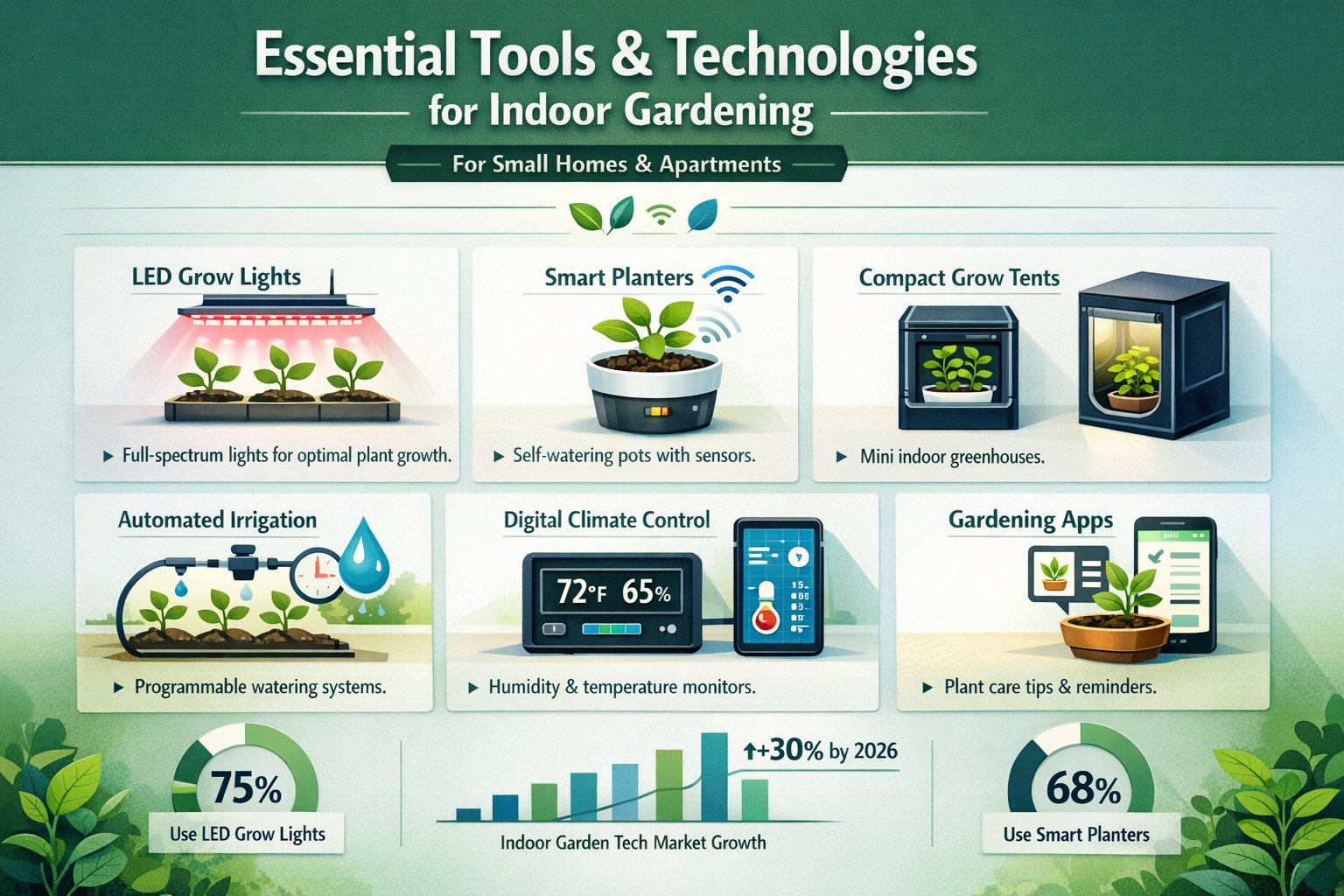
For successful indoor gardening for small homes and apartments in 2026, leveraging essential tools and modern technologies is critical to overcome common challenges like inconsistent watering and insufficient natural light. These advancements simplify plant care, making it accessible even for beginners or those with demanding schedules.
Smart watering systems are gaining significant adoption to address common mistakes in small-space gardening, specifically over- and underwatering [1]. Automated watering systems, soil moisture meters, and watering globes ensure plants receive the precise amount of hydration they need, preventing both root rot and dehydration. Alongside watering solutions, grow lights have become indispensable for precision gardening, especially in apartments with limited natural light [1, 4]. Modern LED grow lights are energy-efficient, discreet, and can be programmed to mimic natural sunlight cycles, allowing plants to thrive in otherwise dark corners or rooms without south-facing windows. These technologies enable apartment dwellers to grow a wider variety of plants, including those with higher light requirements, and ensure consistent growth year-round. For more comprehensive insights into maintaining healthy plants in compact spaces, consider exploring resources on Ultimate Guide to Small Space Gardening for Beginners 2026.
Pros & Cons of Smart Gardening Tech
| Feature/Technology | Pros | Cons |
|---|---|---|
| Smart Watering Systems | Reduces risk of over/underwatering, saves time, consistent hydration, suitable for busy schedules [1]. | Initial cost can be higher, requires setup/calibration, potential for technical glitches, reliance on power/batteries. |
| LED Grow Lights | Enables plant growth in low-light areas, energy-efficient, customizable light spectrum, year-round growth [1]. | Initial investment, may require specific fixtures, some models can be bulky, adds to electricity bill (though often minimal). |
| Soil Moisture Meters | Provides accurate hydration data, prevents guesswork, affordable. | Manual checking required, can be overlooked, less precise than automated systems, needs to be moved between pots. |
| Gardening Apps | Offers care reminders, plant identification, community support, tailored advice [1]. | Requires consistent input, app fatigue, accuracy depends on data quality, internet access needed for some features. |
| Hydroponic Systems | Faster growth, no soil needed, uses less water, clean, great for herbs/veg in small spaces. | Higher initial cost, requires more technical understanding, can be bulky, constant nutrient monitoring needed. |
Edge Case: For apartments with extremely low light conditions or north-facing windows only, a full-spectrum LED grow light system is not just an enhancement but a necessity to sustain most indoor plants, especially if you aim to grow herbs or flowering plants. Relying solely on ambient light in such situations will likely lead to stunted growth or plant death.
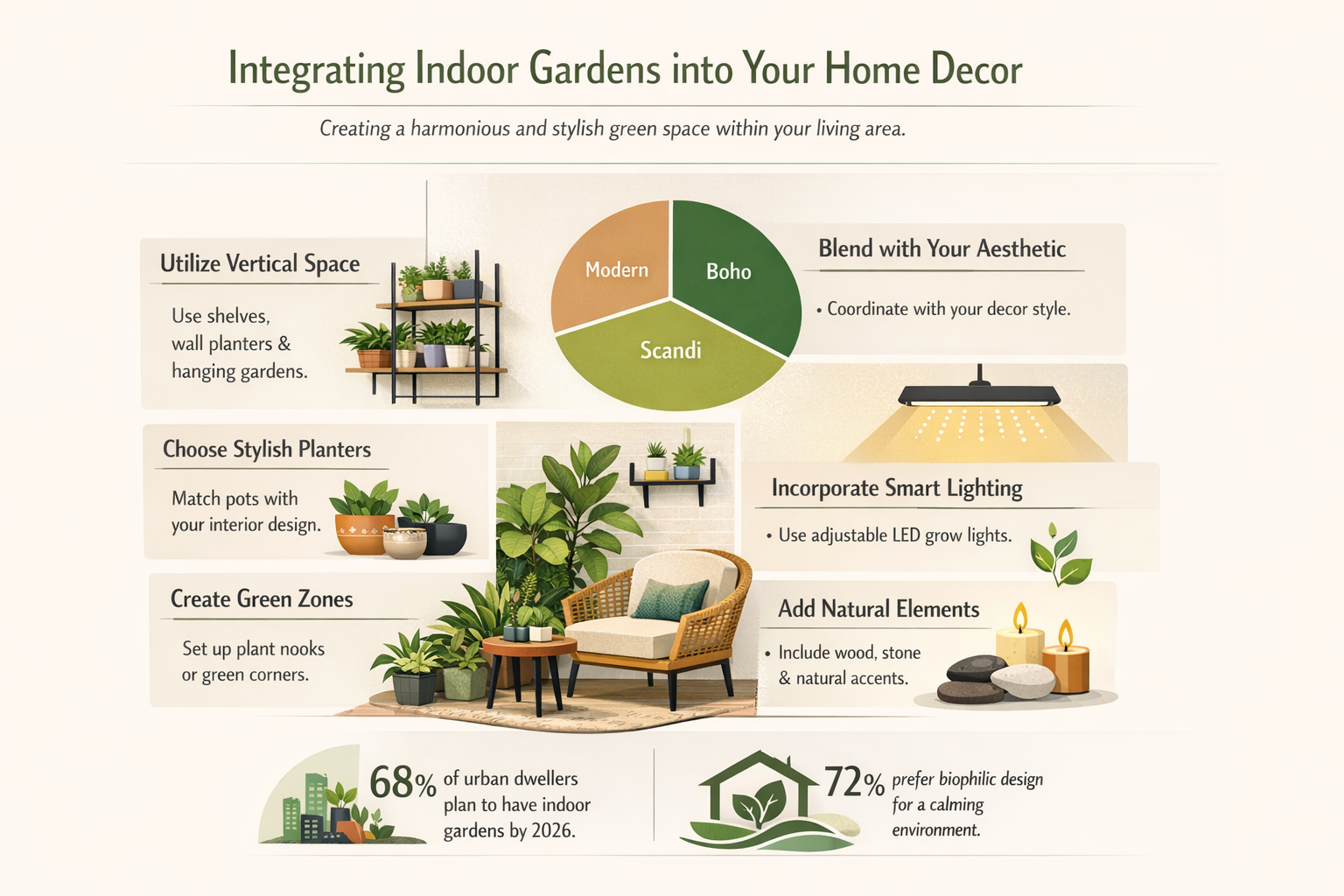
Integrating Indoor Gardens into Your Home Decor
Seamlessly integrating indoor gardens into your home decor in 2026 is about more than just adding plants; it involves strategic placement, thoughtful design choices, and utilizing plants as living art to enhance the overall aesthetic of your small home or apartment. The goal is to create harmonious “wellness nooks” and functional green spaces that complement your interior design.
The trend for 2026 emphasizes creating immersive ecosystems, with designers opting for floor-to-ceiling living walls, vertical herb gardens, and air-purifying moss panels as complete indoor ecosystems rather than standalone potted plants [4]. This approach allows plants to become integral parts of the room’s structure and design. When integrating plants, the “Rule of Three” is a popular expert recommendation: group three plants of different heights together in corners or on surfaces to create intentional “wellness nooks” that feel curated and calming, rather than scattering single plants that might create visual clutter [5]. Furthermore, contemporary designs favor neutral, minimalist planters made of matte ceramic, concrete, or stone, with clean lines and geometric shapes, ensuring they blend seamlessly with modern interiors rather than competing for attention [2]. For more creative solutions and inspiration for enhancing small spaces, consider visiting Mini Space Garden | Small Space Gardening Ideas.
Pull Quote: “In 2026, indoor plants are not just decor; they are becoming living architecture, defining spaces and creating serene ecosystems within our homes.” — Design Trend Analyst [4]
Styling Tips for Small Spaces:
- Create Vertical Focal Points: Use tall, slender plants or vertical gardens to draw the eye upwards, making ceilings appear higher.
- Balance & Symmetry: On shelves or mantels, arrange plants with varying heights and textures but maintain a sense of balance.
- Color Palette Harmony: Choose planters that match your existing decor (e.g., neutral tones for minimalist spaces, earthy textures for bohemian).
- Lighting as Design: Integrate grow lights not just for plant health but as subtle accent lighting to highlight your green displays.
- Define Zones: Use a large, strategically placed plant in a linear planter to subtly divide an open-plan living and dining area without blocking views.
- Layered Greenery: On floating shelves, combine trailing plants (like Pothos) with upright plants (like Sansevieria) and small, bushy plants to create depth.
Common Mistake: Overlooking the scale of the plant relative to the space. A large, bushy plant might overwhelm a tiny side table, while a single small succulent on a vast empty wall will look lost. Always consider the plant’s mature size and how it will interact with its surroundings.
Troubleshooting Common Indoor Gardening Challenges
Troubleshooting common indoor gardening challenges is a vital part of maintaining a healthy green space in small homes and apartments, particularly when dealing with issues like pests, diseases, or nutrient deficiencies. Proactive observation and quick intervention are key to preserving your indoor garden.
One of the most frequent problems in indoor gardening for small homes and apartments is incorrect watering, often leading to either overwatering (causing root rot) or underwatering (leading to wilting) [1]. This can be easily mitigated by using soil moisture meters or setting up smart watering systems [1]. Another common issue is inadequate light, especially in city apartments, which can cause leggy growth, pale leaves, or a lack of flowering. Implementing full-spectrum LED grow lights is an effective solution, allowing you to control the light intensity and duration, ensuring plants receive the necessary light without having to rely solely on natural sources [1, 4]. Pest infestations, such as spider mites or fungus gnats, are also common but can be managed with consistent inspection, proper sanitation (removing dead leaves), and organic pest control methods like neem oil or insecticidal soap.
Table 2: Common Indoor Plant Problems and Solutions
| Problem | Symptoms | Common Causes | Solutions |
|---|---|---|---|
| Yellowing Leaves | Leaves turn yellow, often starting at the bottom. | Overwatering, nutrient deficiency, low light. | Adjust watering schedule, use a moisture meter, fertilize appropriately, move to brighter spot or add grow light. |
| Wilting/Drooping | Leaves sag, plant looks tired. | Underwatering, overwatering (paradoxically), root rot. | Check soil moisture; if dry, water thoroughly. If wet, let it dry out, inspect roots for rot. |
| Brown Leaf Tips | Edges or tips of leaves turn brown and crispy. | Low humidity, inconsistent watering, mineral buildup. | Increase humidity (misting, pebble tray), ensure consistent watering, flush soil periodically. |
| Leggy Growth | Stems are long and stretched, sparse leaves. | Insufficient light. | Move plant to a brighter location, introduce a grow light [1, 4]. |
| Pests (e.g., Fungus Gnats, Spider Mites) | Small flies, webbing, tiny spots on leaves. | Overwatering, poor air circulation, infested new plants. | Let soil dry out between waterings, use sticky traps, neem oil, insecticidal soap, wipe leaves regularly. |
| No New Growth | Plant appears stagnant for weeks or months. | Lack of nutrients, dormant period, insufficient light. | Fertilize if needed, ensure adequate light, check if plant is in its dormant season. |
Actionable Steps for Pest Management:
- Inspect Regularly: Check your plants thoroughly every week, especially the undersides of leaves and new growth.
- Quarantine New Plants: Isolate any new plant additions for a few weeks to ensure they aren’t bringing pests into your existing garden.
- Sanitation: Remove any dead leaves or debris from the soil surface to eliminate potential breeding grounds.
- Organic Treatments: Use neem oil spray or insecticidal soap for active infestations. For fungus gnats, reduce watering and use sticky traps.
Conclusion
Embracing indoor gardening for small homes and apartments in 2026 offers an incredibly rewarding experience, transforming confined living spaces into vibrant, calming, and productive sanctuaries. By thoughtfully selecting low-maintenance plants, cleverly utilizing vertical space with creative planters, and integrating modern technologies like smart watering systems and LED grow lights, apartment dwellers can cultivate thriving green environments regardless of their space limitations or gardening experience. This approach not only enhances aesthetics and improves air quality but also provides a vital connection to nature, significantly boosting mental well-being in an increasingly urbanized world.
The journey of creating an indoor garden is one of continuous learning and adaptation, but the benefits far outweigh the challenges. Start small, experiment with different plant varieties and arrangements, and don’t be afraid to leverage the wealth of smart gardening tools available. Your small home or apartment has the potential to become a lush, green oasis, a testament to the power of nature and intentional design.
Next Steps:
- Assess Your Space: Identify areas with natural light and potential vertical space for planters.
- Choose Your First Plants: Select 2-3 low-maintenance species from our recommended list (e.g., Snake Plant, Pothos).
- Invest in Essential Tools: Consider a soil moisture meter and, if needed, a basic LED grow light.
- Plan Your Layout: Sketch out where your plants will go, considering the “Rule of Three” and vertical solutions.
- Start Small, Learn, and Expand: Begin with a manageable number of plants, observe how they adapt, and gradually expand your indoor garden.
References
[1] Houseplants Trends 2026 – https://www.homesandgardens.com/gardens/houseplants-trends-2026
[2] Modern Indoor Garden Ideas To Elevate Your Home Decor In 2026 – https://thegardenian.com/modern-indoor-garden-ideas-to-elevate-your-home-decor-in-2026/
[3] Garden Trends For 2026 – https://www.gardeningknowhow.com/garden-how-to/design/garden-trends-for-2026
[4] Cultivating Sanctuary Interior Design Trends Shaping 2026 – https://soltech.com/blogs/blog/cultivating-sanctuary-interior-design-trends-shaping-2026
[5] Choosing The Right Plants For 2026 Interior Trends – https://soltech.com/en-ca/blogs/blog/choosing-the-right-plants-for-2026-interior-trends
[6] Gardening Trends For 2026 Designing With Intention Balance And Care – https://swanhose.com/blogs/general-gardening/gardening-trends-for-2026-designing-with-intention-balance-and-care
[7] Plant Styling Trends For 2026 – https://urbaneeight.com/blogs/news/plant-styling-trends-for-2026
[8] Watch – https://www.youtube.com/watch?v=BxmOSqtJ2Q8
[9] Gardening Trends 2026 – https://www.housebeautiful.com/uk/garden/plants/a69817540/gardening-trends-2026/